Showing posts with label 1995. Show all posts

Tuesday, March 4, 2025

Indianapolis Movers


Headquartered in Indianapolis, Indiana, Bekins Van Lines, Inc. is the oldest, currently operating, and the first to specialize in moving household goods in the United States and North America. Founded by brothers John Bekius and Martin (Bekius) Bekins in 1891, Bekins began operations in Sioux City, Iowa, with just three horse-drawn vans and twelve employees. In 1894, Martin Bekins brought the business to Los Angeles.  Bekins also offers special commodities and logistic services with the United States Military being one of their largest customers. In 2012, Wheaton Van Lines became the parent company of Bekins.


Mayflower was founded in Indianapolis, Indiana in 1927 by trucker Conrad M. Gentry, formerly of Red Ball Transit Company, and International Harvester truck salesman Don F. Kenworthy. Starting with only two trucks, the business topped $500,000 by 1932 despite the Great Depression. Mayflower became the first trucking company in the industry to receive operating rights in all forty-eight states in 1940. Mayflower emerged from a 1991 bankruptcy one year later. The Unigroup, an American moving company based in Fenton, Missouri, purchased Mayflower in 1995 and moved its headquarters to the St. Louis suburb.

Tuesday, May 30, 2023

Planned Obsolescence


Brooks Stevens (1911-95) was an American industrial designer, born in Wisconsin and active in Milwaukee. Stricken with polio as a child, he was encouraged by his father to practice drawing while confined to his bed, perhaps motivating his career in design. He studied architecture at Cornell University from 1929 to 1933 and established his own home-furnishings design firm in 1934 in Milwaukee. In 1936 he designed the first electric clothes drier. He transformed it from the manufacturers’ concept of a simple heated box into an apparatus that had a glass window built into its door. His works had mass appeal and were fuelled by the fact that many of his works were functional daily life objects. 

In 1944, he established Brooks Stevens Associates, embracing a partnership of four executive designers and a staff of twelve. Some of the company’s automotive clients included Packard, Willys, Studebaker, Excalibur, American Motors and many others. Brooks was involved in the creation of the first snowmobile, the Evinrude outboard motor, and a mass-market jeep. The 1950 Harley-Davidson motorcycle, the 1958 Oscar Mayer Wienermobile in fiberglass, and the 1959 Lawn Boy lawnmower were also Stevens' designs. He may be best known for designing the 1962 Studebaker Hawk Gran Tourismo (above), and the Skytop Lounge observation cars for the Chicago, Milwaukee, St. Paul & Pacific Railroad's Hiawatha passenger trains.
 
Legend has given at least partial credit to Stevens for popularizing the term, planned obsolescence, which he defined as "instilling in the buyer the desire to own something a little newer, a little better, a little sooner than is necessary." Though debatable, his view was to always make the consumer want something new, rather than create poor products that would need replacing.

Thursday, January 26, 2023

Television Talkers: The Early Years


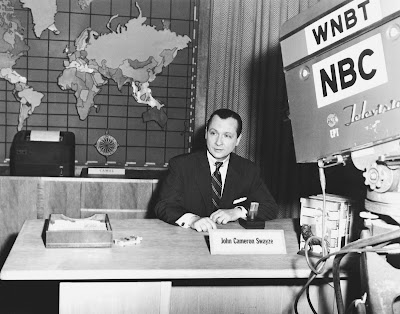
John Cameron Swayze (1906-1995) was an American news commentator 
during the 1940s and 1950s who later became best known as a product spokesman. Born in Wichita, Kansas, Swayze initially sought to work as an actor. However, the Wall Street Crash of 1929 curtailed acting roles on Broadway and he ended up in radio by 1933.

Swayze hosted the radio program Stranger Than Fiction. In addition, he worked in sports, writing about and broadcasting football games, and took part in early experimental television broadcasts. By 1940, Swayze was working full-time doing news updates for Kansas City's KMBZ. He broadcast news items prepared by United Press Kansas City bureau overnight editor Walter Cronkite. By 1946, Swayze was hired by NBC as director of news and special events for its Western Division. Two years later, NBC produced The Camel Newsreel Theatre, a 10-minute program of daily events using newsreel film, which Swayze narrated and often scripted.

Eventually, NBC executives tired of Swayze's flamboyant delivery style, in contrast to anchorman Douglas Edwards's comparatively low-key delivery on CBS. The ouster offered him various television roles as a game show panelist and product pitchman. For twenty years beginning in 1956, Swayze became widely known as the commercial pitchman for Timex watches, subjecting Timex watches to grueling physical tests. After retrieving the watch, his authoritative delivery was perfect for the company's slogan, "It takes a licking and keeps on ticking." 

Thursday, October 20, 2022

Woodward Avenue Nostalgia


Michigan highway 1 (M-1), commonly known as Woodward Avenue, is a north–south state trunkline highway in the Detroit Metro area. The highway, called "Detroit's Main Street", runs from Detroit north-northwesterly to Pontiac. Woodward Avenue was created after the Detroit Fire of 1805. The thoroughfare followed the route of the Saginaw Trail, an Indian trail that linked Detroit with Pontiac, Flint, and Saginaw. The Saginaw Trail connected to the Mackinaw Trail, which extended north to the Straits of Mackinac at the tip of the Lower Peninsula of Michigan.

Today, Woodward Avenue is most famous for its "Woodward Dream Cruise" held each August. Founded in 1995 as a fundraiser for a soccer field in Ferndale, it takes place on Woodward Avenue between Pontiac and Ferndale. But there is a long history of crusing Woodward Avenue. In 1848, young carriage drivers raced one another along the avenue after the roadway was converted from logs to planks. By 1958, the roadway was used for unofficial street racing with cars. The wide width, median and sections lacking a large commercial presence attracted a reputation for the competition. 

The above photos compare the intersections of Woodward and Farnsworth in 1901 and today.