Showing posts with label 1949. Show all posts

Wednesday, February 28, 2024

Dum-de-dum-dum


Radio's Dragnet became one of the most realistic and popular programs of all time. As played by Jack Webb, Sergeant Joe Friday played it by the book and understood the seriousness of his duties. The program’s debut in 1949 was bumpy as Webb and company worked out the format and grew more comfortable with their characters. Friday's deadpan, fast-talking persona emerged as a cop's cop, tough but not hard. Webb was a stickler for accuracy and Dragnet used authentic touches, such as the LAPD's actual radio call sign and the names of actual department officials. The crime stories were taken from actual case files of the Los Angeles Police Department. The ominous, four-note theme with brass and tympani entitled, "Danger Ahead," was composed by Walter Schumann. It is derived from Miklós Rózsa's score for the 1946 film The Killers. The notes are the same for both but the film’s faster, steady tempo disguises it from Dragnet's halted rhythmic version.

Friday took his orders from Ed Backstrand, Chief of Detectives, played initially by Raymond Burr, then Charles McGraw. Both left the series within a year for budding film careers. Friday had a partner, and each actor brought their own personality to the series. Barton Yarborough as Sergeant Ben Romero, perhaps provided the most realism. His untimely death in 1951 brought in character actor Barney Phillips as Sergeant Ed Jacobs for a short run. The longest-serving partner was Ben Alexander (below left) as Officer Frank Smith. Smith would talk to Friday about his family or give advice, often with amusing results. Friday offered voice-over narration throughout the episodes, noting the time, date and place of every scene. Dragnet handled controversial subjects such as sex crimes and drug addiction with unprecedented and even startling realism.


The sound effects artists were extraordinary and brought realism to the show. The pictures in a listener's mind were all that was needed. While most radio shows used one or two Foley experts, Dragnet used five. A script clocking just under thirty minutes could require up to 300 effects. Accuracy was key. The exact number of footsteps from one room to another at Los Angeles police headquarters were mimicked, and when a telephone rang at Friday's desk, the listener heard the same ring as the telephones in Los Angeles police headquarters.

The show's opening narration was alternately provided by announcers Hal Gibney and George Fenneman, just one of the show's trademarks: "Ladies and gentlemen, the story you are about to hear is true. Only the names have been changed to protect the innocent." Later versions dropped the words "only" and "ladies and gentlemen." Friday's oft-parodied catchphrase, "Just the facts, ma'am," was never actually uttered. The closest was "All we want are the facts, ma'am" and "All we know are the facts, ma'am." Fenneman took over narration duties full-time after 1957 and for the two television series.

Note: Due in part to Webb's fondness for radio drama, Dragnet persisted until 1957. The last two seasons were repeats, however. It was one of the last old-time radio shows to give way to television. A total of 314 original episodes were broadcast from 1949-1957. The TV show proved to be a visual version of the radio scripts, more in line with the Ben Alexander days with Harry Morgan as Friday's partner. The radio show was also adapted into a comic strip by Mel Keefer.

Wednesday, March 2, 2022

Non-Stop Around The World


On this date in 1949, a Boeing B-50A Superfortress, named Lucky Lady II, ended its four-day, non-stop circumnavigation of the Earth, landing back at Carswell AFB, Fort Worth, Texas. The bomber received four inflight refuelings for its 94 hours and 1 minute, 23,452-mile flight. Lucky Lady II was the backup aircraft for this flight but became primary when the first B-50, Global Queen, had to abort with engine problems. Each Lucky Lady II crew member was awarded the Distinguished Flying Cross and the Mackay Trophy for the most meritorious flight of the year. Aerial refueling proved there was no distance out the reach for the Strategic Air Command.

13 August 1950, while returning to its base at Davis-Monthan AFB, Tucson, Arizona, all four engines failed. Unable to reach the runways, the pilot landed safely in the desert approximately two miles away. Though the landing gear was extended, the bomber collapsed and was damaged beyond economic repair. The unrestored fuselage of Lucky Lady II is at the Planes of Fame Air Museum, Chino, California.

Monday, July 26, 2021

One-Third Cavalry Trilogy


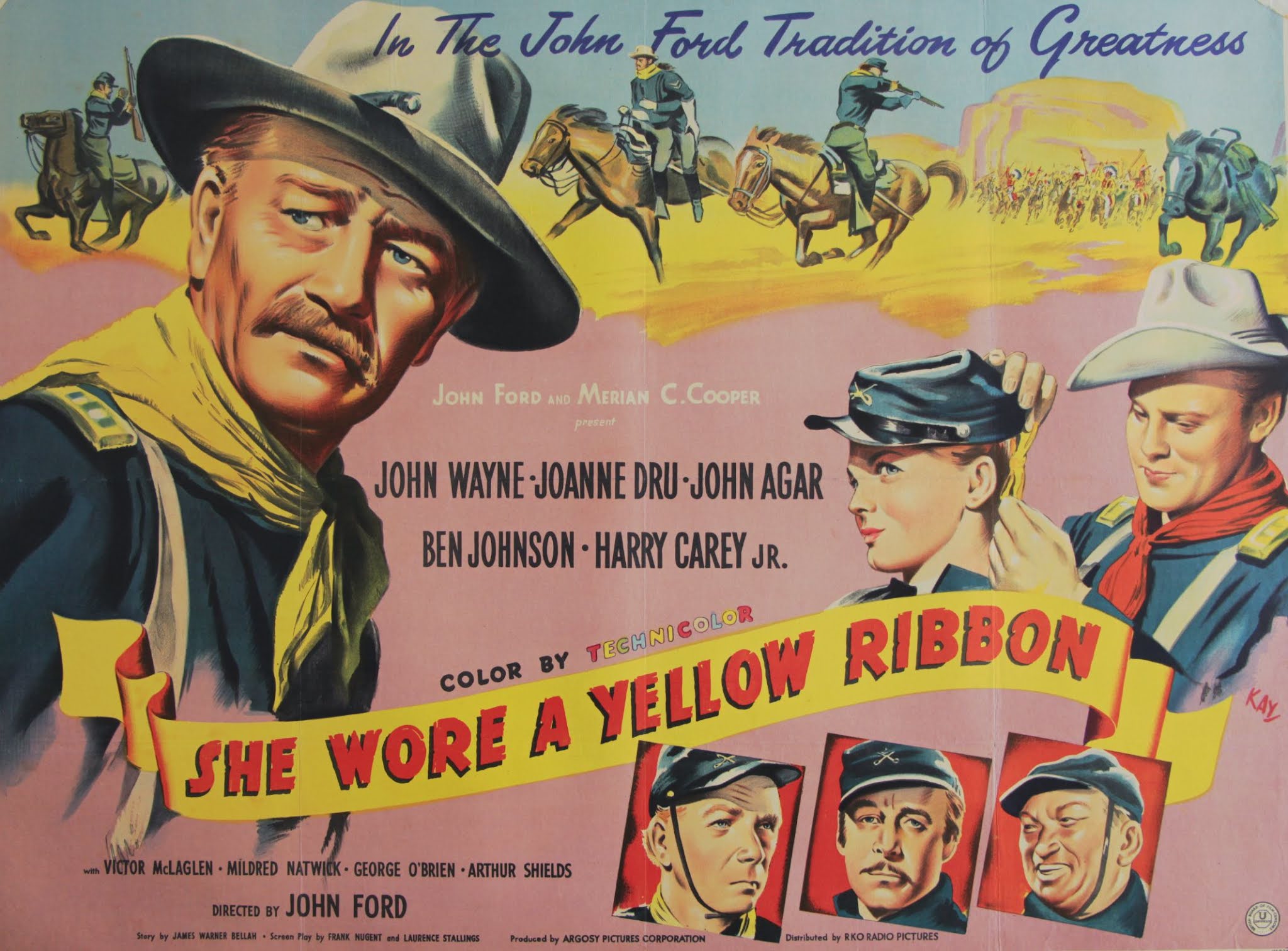
On this date in 1949, She Wore a Yellow Ribbon premiered in Kansas City, Kansas. The technicolor Western film, directed by John Ford and starring John Wayne, is the second film in Ford's "Cavalry Trilogy," along with Fort Apache (1948) and Rio Grande (1950). With a budget of $1.6 million, the film was one of the most expensive Westerns made at the time and was a major hit for RKO. The film was stunningly shot on location in Monument Valley utilizing large areas of the Navajo reservation along the Arizona-Utah state border. Cinematographer Winton C. Hoch based much of the film's imagery on the paintings and sculptures of Frederic Remington. Hoch won the Academy Award for Best Cinematography, Color in 1950. The film's title takes its name from a popular US military song that is used to keep marching cadence.

Thursday, April 15, 2021

Revolutionizing World Air Travel


Flying in the lap of luxury was the hype for Pan American World Airways's Boeing 377 Stratocruiser with its lower-level lounge. The Stratocruiser's first flight was in 1947 and Pan American took charge of 29 in 1949, twenty years before they bought the Boeing 747. Pan American was the first operational airline of both types and each became game-changers. 

The large long-range airliner was developed from the C-97 Stratofreighter military transport, itself a derivative of the B-29 Superfortress. Advanced for its day, its innovative features included two passenger decks and a relatively new feature on transport aircraft, a pressurized cabin. Though larger than the Douglas DC-6 and Lockheed Constellation competition, it cost more to buy and operate and the reliability of its complex Pratt & Whitney R-4360 Wasp Major radial engines had issues. Its dominance was short-lived as Boeing's own 707 jet airliner overwhelmed the 377's performance in less than a decade.

Friday, April 2, 2021

Body by Fisher


"Pound for pound -- what do you find?" is the headline accompanying this 1949 illustration. Do all sorts of pounding, thumping and slamming to discover the solidity of steel. I guess. The Fisher Body Corporation was a Detroit, Michigan automobile coachbuilder founded by the Fisher brothers in 1908 but its beginnings trace back to a horse-drawn carriage shop in Norwalk, Ohio, in the late 1800s. Since 1919 a division of General Motors, it was dissolved to form other GM divisions in 1984. Noted for many innovations, Fisher Body designed slanted windshields to reduce glare in 1930, dual windshield wipers in 1936 and produced GM's first airbag in 1974. The name and its iconic "Body by Fisher" logo were well known to the public, as GM vehicles displayed the emblem on their door sill plates until the mid-1990s.