Showing posts with label western. Show all posts

Tuesday, June 10, 2025

RKO Blood on Fort Apache

The films below were released by RKO Radio Pictures in 1948, and they are two famous Western films with different premises. Though both deal with a clash of personalities, one is a traditional Western, while the other is a shadowy, moody, noir Western.

Fort Apache
Released March 27, 1948, Fort Apache is an American Western saga, the first of John Ford's "Cavalry Trilogy." It was followed by She Wore a Yellow Ribbon (1949) and Rio Grande (1950), all starring John Wayne. The film was one of the first to present an authentic and sympathetic view of Native Americans.

Wayne's substantial co-star is Henry Fonda, supported by a talented cast including Shirley Temple, Pedro Armendariz, and John Agar. Cinematography is by Archie Stout. Fonda plays an arrogant and abrasive Lieutenant Colonel in command of Fort Apache, much to Wayne's disappointment, who had expected to receive that commission.

Blood On The Moon

Released November 9, 1948, Blood on the Moon is considered one of the best noir Westerns, in contrast to the sunlit saga of Fort Apache. It is a moody, "psychological" film starring Robert Mitchum, a role that neither Wayne nor Fonda could pull off. There is little of the Western formula approach to this story. The supporting cast includes Robert Preston, Walter Brennan, and Barbara Bel Geddes. The film is directed by another legend in cinema, Robert Wise. The outstanding cinematography is by Nicholas Musuraca. 

Of note is an extended fight between Mitchum and Preston without any stuntmen. Then again, it took three days to shoot. Wise wanted realism, where the winner is also badly beaten and exhausted, instead of a cliched brawl where the hero comes out clean and unscathed. Mitchum's acting was lauded at the time, whereas both Wayne and Fonda somewhat cancelled each other out of any accolades.

Note: 
From a budget of approximately $2.1 million, Fort Apache had a box office total of $3 million. Blood On The Moon made a decent profit out of a $1.5 million budget with a $2.4 million box office take.

Wednesday, June 19, 2024

Synopsis: Thrust Into Television

Many movie character actors found steady work and arguably more exposure with the advent of television. 


MYRON HEALEY (1923-2005) 

Healey's characters may be despised more than others in film or television during the 1950s, thanks to his condescending delivery as a villain. When Healey was "bad," he could be despicable. He somewhat carried the torch from actor Harry Lauter, nine years his elder. He appeared in some 140 films, including more than 80 westerns, frequently for Monogram Pictures. But it was television that brought him intimate exposure. Healey served in World War II as an Air Corps navigator and bombardier, flying in B-26 Martin Marauders in the European Theatre. After the war, he continued military duties, retiring in the early 1960s as a captain in the United States Air Force Reserve.

Discover more about Healey's career at IMDB.

Monday, April 22, 2024

On This Date


On this date, Wagon Master, the American Western masterpiece produced and directed by John Ford, premiered in 1950. Starring Ben Johnson, Harry Carey Jr., Joanne Dru, and Ward Bond, the story follows a Mormon pioneer wagon train across treacherous terrain to Utah. The film inspired the US television series Wagon Train (1957–1965), which starred Bond until 1960.

Tuesday, November 22, 2022

A Television Full of Mavericks


Bringing back the old western, Maverick, into an era when westerns were not as popular, seems like a long shot for success. It was. The first attempt was a 1978 TV-movie, The New Maverick, reprising James Garner as Bret and Jack Kelly as Bart. It served as a pilot movie for The Young Maverick, starring Charles Frank as Ben Maverick. The movie was not a rousing success. The new series even less so, running from November 28, 1979 to January 16, 1980. The lack of the Garner's sardonic style was obvious. After The Rockford Files shut down, even Garner could not revive his popular series in, Bret Maverick, only running from December 1, 1981 to May 4, 1982.

Wednesday, February 2, 2022

Three Crosses at The Little Big Horn


There were a number of entertaining westerns co-produced by Harry Joe Brown and Randolph Scott. The Tall T, Decision at Sundown, Ride Lonesome, and Comanche Station are among the best. Scott is perfectly cast in these low-budget westerns. Despite some historical inaccuracies, not the least of which is period-correct apparel, they are enjoyable thanks to Scott's screen presence. One of his weaker entries in their partnership, however, was 1956's, 7th Cavalry. 

With its slow pace and talky script, the film never reaches much of a climax and lacks believability on several fronts. Acknowledging Hollywood's common practice, Scott's character never historically existed though he is surrounded by historically accurate individuals. Glaring is that Scott's character was a close friend and supporter of George A. Custer. But without a doubt, the most unforgivable error is the three times the real Randolph Scott's mispronunciation of the 7th Calvary, not 7th Cavalry. The two words could not be more diametrically opposed. Obviously, no one was aware of the Biblical location or bothered to retake the scenes. 

Wednesday, January 26, 2022

Reel Character Series


Jack Lambert (John Thomas Lambert 1920-2002) was an American character actor who specialized in playing movie tough guys and heavies. His pre-war roles were typically uncredited until film-noir picked up pace. With his craggy face, squinty eyes, and a gruff voice to match, he was a familiar figure in westerns and crime dramas in such post-war movies as The Killers, in a gravitating role as "Dum-Dum" Clarke, The Enforcer, Bend of the River, and Vera Cruz. For many, his first memorable role might have been playing the psychotic cat-loving, iron-hooked Steve "The Claw" Michel in Dick Tracy's Dilemma. He was a human punching bag, underestimating the fists of prizefighter, John Payne, in 99 River Street. Two years later, he played Sugar Smallhouse in, Kiss Me Deadly. Lambert seemed to garner some of the best character names in film.

His one-dimensional characters shifted his career primarily to the small screen with numerous television appearances during the 1950s and 1960s in such shows as Rod Cameron's State Trooper, Gunsmoke, Have Gun – Will Travel, Sugarfoot, Wagon Train, and Bonanza. He had a recurring role as a cast member in the Darren McGavin series, Riverboat. Lambert appeared in the occasional comedy movie or television series. Still playing a thug. He was a Zombie in Martin and Lewis' Scared Still of 1953. Lambert had a humorous turn as a thoughtful hitman alongside singer/comedian, and Jack Benny regular, Dennis Day, in the 1959 dark comedy episode, Cheap is Cheap, for Alfred Hitchcock Presents. Lambert meets Day in a park to discuss doing away with his high-maintenance wife. Lambert empathically offers options but his fee is too high. He then suggests Day could do it himself. 

Retiring in 1970, he and his wife ran (of course) a boutique in Carmel, California.

Wednesday, December 29, 2021

The Western Gone Wrong

Tumbleweeds is a satirical perspective on the American frontier. The comic strip ultimately ran in over 300 newspapers from September 6, 1965, to December 30, 2007. Writer-artist Tom K. Ryan (1926-2019) offered deadpan humor to poke fun at all the clichés and stereotypes of western movies. Set in and around the town of Grimy Gulch with a population that hovered up or down of 50, it was one of the longest-running western comics made continuously by the same author. Ryan had a large following among Native Americans because of his respectful use of those characters. 

The comic strip was remarkable for its large cast of 50 wacky-named characters. The title character (above) got his namesake from the dried-out pieces of plants that tumble away in the wind. It symbolized the laconic cowpoke who has no real ambition to do anything. Much of the comic's humor came from its silly dialogue and the artist's over-the-top stylized characters for both humans and animals. Tumbleweeds is sometimes compared to Johnny Hart's popular B.C. or Wizard of Id strips. The comic strip's dry humor had a target audience, but aside from a nostalgic return, the strip has lost much of its relevance today. Good examples can be found at Tumbleweeds.

Note: From 1969 until 1978, Ryan's assistant was Jim Davis, of "Garfield" fame. Both men worked in Muncie, Indiana. 

Monday, July 26, 2021

One-Third Cavalry Trilogy


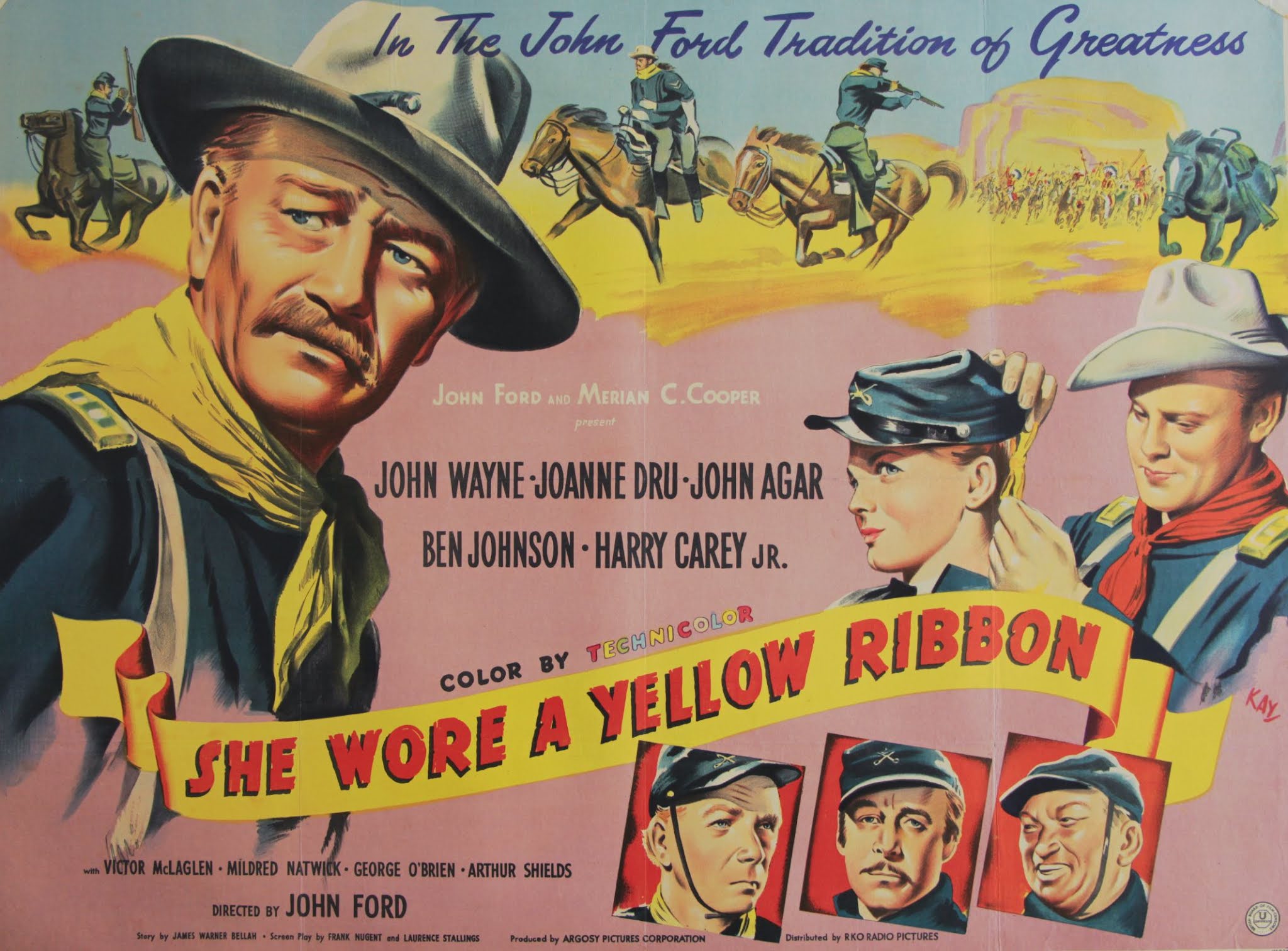
On this date in 1949, She Wore a Yellow Ribbon premiered in Kansas City, Kansas. The technicolor Western film, directed by John Ford and starring John Wayne, is the second film in Ford's "Cavalry Trilogy," along with Fort Apache (1948) and Rio Grande (1950). With a budget of $1.6 million, the film was one of the most expensive Westerns made at the time and was a major hit for RKO. The film was stunningly shot on location in Monument Valley utilizing large areas of the Navajo reservation along the Arizona-Utah state border. Cinematographer Winton C. Hoch based much of the film's imagery on the paintings and sculptures of Frederic Remington. Hoch won the Academy Award for Best Cinematography, Color in 1950. The film's title takes its name from a popular US military song that is used to keep marching cadence.

Monday, May 3, 2021

An American King


Wright King (Thomas Wright Thornburg King 1923-2018) was an American stage, film and television actor with a career spanning nearly thirty years. His lengthy career placed him in stage productions on both sides of the Atlantic as well as a prolific supporting actor on numerous television series. After serving in the Navy in WW2, he continued his studies in New York at the Actors Studio and the American Theatre Wing. He garnered critical acclaim in the original Broadway production of “A Streetcar Named Desire” (1947-49). He was quite visible in his one-season role on “Wanted Dead or Alive” (above) and co-starred in two classic “The Twilight Zone” episodes, "Shadow Play" (1961) and “Of Late I Think of Cliffordville” (1963). He was “unseen” in the original “Planet of the Apes” as the chimpanzee veterinarian, Dr. Galen.