Showing posts with label 1920. Show all posts

Tuesday, March 18, 2025

Sulfa-thiazole For Me


The Band-Aid was invented in 1920 by a Johnson & Johnson employee, Earle Dickson, for his wife who often cut or burned herself while cooking. It was dangerous back then. The prototype allowed her to dress her wounds without assistance. Dickson passed the idea on to his employer, who went on to produce and market the product as the Band-Aid. By 1924, Johnson & Johnson introduced machine-made Band-Aids. Two years later, the iconic tin packaging debuted. Once people used all the contents, the empty tins became popular canisters to hold everything from nails and buttons to marbles and baseball cards. The sale of sterilized Band-Aids began in 1939 with a little red string in the packaging to easily tear it open. 

Today, the Band-Aid brand of adhesive bandages is distributed by the consumer health company Kenvue, spun off from Johnson & Johnson in 2023. The brand has become a generic term for adhesive bandages in many countries. Well over one billion Band-Aid brand adhesive bandages have been produced.

The above illustration is from 1943

Friday, July 19, 2024

Synopsis: Thrust Into Television

Many movie character actors found steady work and arguably more exposure with the advent of television. 


MICHAEL PATE (1920-2008) 

Michael Pate was an Australian actor, writer, director, and producer, better known for his prolific work as a supporting actor in Hollywood films and American Television during the 1950s and 1960s. His range of characters spanned the globe. Though with only a slight variation of an accent, he may be most familiar as an American Indian, a Turkish ruler or guide, or an Eastern European spy or assassin. As a guest star, he played villains in American television comedies, including Batman (1966).

After serving during World War II, Pate had a brief acting career in his native country before heading to Hollywood in the 1950s. He appeared in over 300 television shows and films, including his most distinct introduction in 1954 for a
Climax! live production of Ian Fleming's Casino Royale. Pate played the role of "Clarence Leiter," opposite Barry Nelson's "Jimmy Bond." Two years later, he was cast in a supporting role in Danny Kaye's masterpiece comedy, The Court Jester. Numerous sources list all his films, some of which are notably famous.

During his time in the United States, Pate became an acting instructor and lecturer, and wrote many screenplays and plays for American films and television series. He appeared in nearly all the popular television Westerns during the decade as well as many adventure shows, before returning to Australia to become a television producer, winning two Logie Awards for his efforts. Pate retired in 2001 but kept busy doing voice-over work and writing screenplays.

Friday, September 1, 2023

Design Longevity


Saul Bass (1920-1996) was an American graphic designer and Oscar-winning filmmaker, best known for his design of motion-picture title sequences, film posters, and corporate logos. During his 40-year career, he worked for some of Hollywood's most prominent filmmakers. His iconic title sequences for Man with the Golden Arm (1955), North by Northwest (1959), Vertigo (1958), working with John Whitney, and Psycho (1960). Bass used a variety of techniques, from cut-out animation for Anatomy of a Murder (1958) to fully animated mini-movies. As a graphic designer, Bass designed some of the most iconic corporate logos in North America, including Geffen Records, the 1968 Continental Airlines jet stream logo, United Airlines' 1974 stylized "UA" as a tulip logo, the 1972 Warner Bros. "Big W" logo, and AT&T Corporation's first globe logo in 1983. 

Some additional samples of Saul Bass's designs here.

Wednesday, June 14, 2023

Yes, Virginia, There Are Two


From left are Virginia Christine (1920-96) and Virginia Gregg (1916-86). Both enjoyed a lengthy careers in radio dramas, film, and television. Both were talented voice actresses as well. Both were Midwest-born yet both died in California. They started their film careers in the mid-1940s, often uncredited. Gregg was a busy radio actor and worked frequently with Jack Webb's Dragnet radio and television series among many other shows. Christine became widely known as the matronly Mrs. Olson, the Folgers coffee spokesperson on television commercials for twenty-one years. Her hometown of Stanton, Iowa, honored her by transforming the city water tower to resemble a giant coffee pot.

Thursday, February 9, 2023

Twentieth Century Talkers


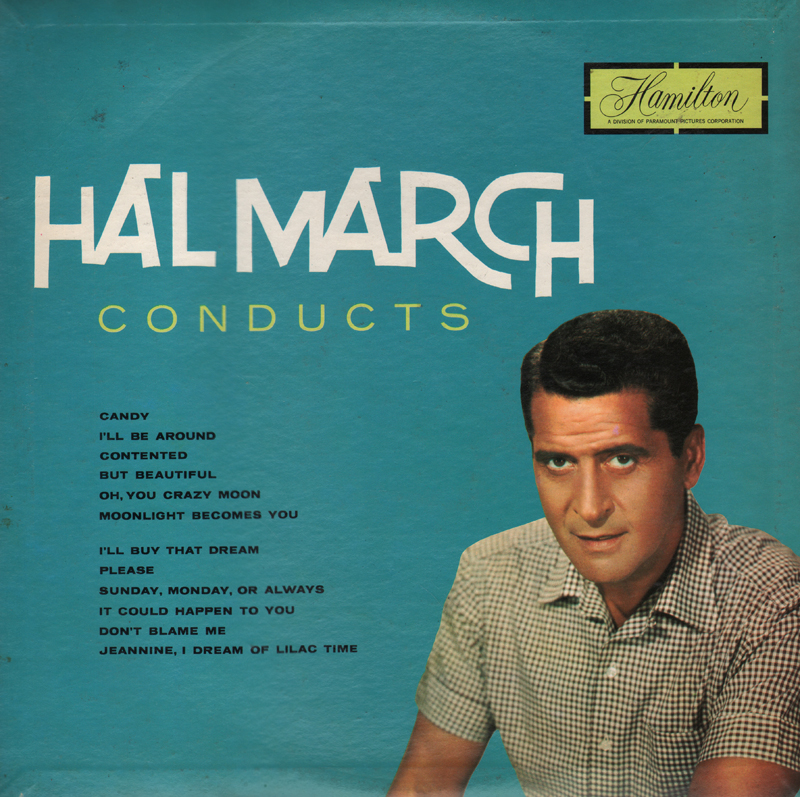
Hal March (Harold Mendelson 1920-1970) was an American comedian, actor as well as accomplished musician and conductor. March began his career in broadcasting as an announcer in San Francisco. After World War II he teamed with Bob Sweeney for The Bob Sweeney-Hal March Show on CBS Radio until 1948. He also appeared in The Adventures of Sam Spade on CBS from 1946-1949. March co-starred as Harry Morton for sixteen episodes of The George Burns and Gracie Allen Show on the NBC and CBS radio networks from the mid-1940s until 1950. When the show switched to television that year, he was replaced mid-season in 1951 by Fred Clark.

March's heyday was the 1950s. His popularity and comedic style cast him in single episodes of many popular shows of the era. The exceptions are four episodes of My Friend Irma and six appearances as himself on The Dennis Day Show. Today, March may be best known for his "guilt by association" with The $64,0000 Question scandal period. Unaware of the producer's and contestant's fraud, his career nevertheless suffered somewhat. In 1961, he played the lead in Neil Simon's first Broadway play Come Blow Your Horn, a hit that ran 677 performances. March finished out his career in 1968, though with fewer television appearances. 

Note: I have found it difficult to uncover much about Hal March's musicianship. In tribute, I have included one of his albums above. 

Monday, March 28, 2022

The First Palm Sunday Tornado Outbreak


On this day in 1920, at least 37 tornadoes, the majority significant F3, F4s, took place across northern, Indiana, western Ohio, southern Michigan and southeast Illinois on the first Palm Sunday weather disaster. The more famous 1965 outbreak, the second on a Palm Sunday, was even more deadly. The 1920 tornadoes killed over 380 and at least 1,215 were injured. Many were caught off-guard as the storms moved northeast at speeds over sixty miles per hour. Most of the fatalities occurred in Georgia (201), Indiana (56), and Ohio (55). 

Charts and photos for 1920 and 1965 tornado outbreaks.

Tuesday, February 8, 2022

The Dependable Fallback Host


Bill Cullen (1920-1990) was an American radio and television personality whose career spanned five decades. His biggest claim to fame was as a game show host for twenty-three shows, earning him the nickname "Dean of Game Show Hosts." Cullen's broadcasting career began in 1939 in Pittsburgh as a disc jockey and play-by-play announcer for the Pittsburgh Steelers and Pittsburgh Hornets. After serving in the Civil Air Patrol as an instructor and patrol aircraft pilot during World War II, Cullen got his first television game show, Winner Take All, in 1952.

The witty busy Bill was on the network's list as their fallback guy. When no one could think of someone new, they typically went with the engaging personality of Cullen. In the mid-Fifties, he hosted Name That Tune, and from 1956 to 1965 he hosted the initial daytime and primetime versions of The Price Is Right. For three seasons he hosted Eye Guess, beginning in 1966. The show spawned a board game version, as well. Throughout the Sixties and Seventies, he hosted some new generations of game shows, most of which had a short life. Cullen was certainly a household face, appearing as a guest on countless game shows including popular shows like The Cross-Wits, Password, Pyramid, and Match Game. But most famously as a panelist on I've Got a Secret from 1952 to 1967, and To Tell the Truth from 1969 to 1978.

Note: Cullen contracted polio when he was 18 months old. That long-term disability plus injuries sustained in a serious motor vehicle accident in 1937, made it difficult for him to walk or stand for extended periods. The game show directors took great care and limited his standing or walking. Few peers knew of his disability at the time and nearly every television viewer ever noticed.

Wednesday, January 26, 2022

Reel Character Series


Jack Lambert (John Thomas Lambert 1920-2002) was an American character actor who specialized in playing movie tough guys and heavies. His pre-war roles were typically uncredited until film-noir picked up pace. With his craggy face, squinty eyes, and a gruff voice to match, he was a familiar figure in westerns and crime dramas in such post-war movies as The Killers, in a gravitating role as "Dum-Dum" Clarke, The Enforcer, Bend of the River, and Vera Cruz. For many, his first memorable role might have been playing the psychotic cat-loving, iron-hooked Steve "The Claw" Michel in Dick Tracy's Dilemma. He was a human punching bag, underestimating the fists of prizefighter, John Payne, in 99 River Street. Two years later, he played Sugar Smallhouse in, Kiss Me Deadly. Lambert seemed to garner some of the best character names in film.

His one-dimensional characters shifted his career primarily to the small screen with numerous television appearances during the 1950s and 1960s in such shows as Rod Cameron's State Trooper, Gunsmoke, Have Gun – Will Travel, Sugarfoot, Wagon Train, and Bonanza. He had a recurring role as a cast member in the Darren McGavin series, Riverboat. Lambert appeared in the occasional comedy movie or television series. Still playing a thug. He was a Zombie in Martin and Lewis' Scared Still of 1953. Lambert had a humorous turn as a thoughtful hitman alongside singer/comedian, and Jack Benny regular, Dennis Day, in the 1959 dark comedy episode, Cheap is Cheap, for Alfred Hitchcock Presents. Lambert meets Day in a park to discuss doing away with his high-maintenance wife. Lambert empathically offers options but his fee is too high. He then suggests Day could do it himself. 

Retiring in 1970, he and his wife ran (of course) a boutique in Carmel, California.

Thursday, June 24, 2021

Not The Arthur Toy Company


Buddy L is an American toy brand and company founded in 1920 by Fred Lundahl as the Buddy L Toy Company in East Moline, Illinois. The all-steel products were pressed into toy cars, dump trucks, delivery vans, fire engines, construction equipment, and trains. The Lundahl's first and only child, Arthur, was nicknamed "Buddy L" to differentiate him from another neighborhood boy named Buddy. I imagine Arthur was the envy of the neighborhood as his doting father constructed numerous toy vehicles for him, some of which were large enough to sit upon and propel with his feet. Lundahl persuaded Marshall Field and FAO Schwarz to carry his line, which did very well until the Depression. He then sold the company and it has bounced around between different owners ever since, distancing itself from its original realism with each venture. 

Note: The 1960 steel Buddy L pickup truck/camper pictured is identical to one I had. The active front spring suspension was mighty impressive. The hard plastic camper could be removed if one chose to do so. Eventually, I did so. 

Monday, February 22, 2021

Take a Greyhound to California


On this day in 1920, a mechanical lure, described in the press as the "automatic rabbit" was first used in greyhound racing. The modern greyhound racing industry emerged in its recognizable form---circular or oval tracks---with the invention of the mechanical, or artificial, hare in 1912 by American, Owen Patrick Smith. Smith had altruistic aims for the industry to stop the killing of the jackrabbits and see "greyhound racing as we see horse racing". In 1919, Smith opened the first professional dog-racing track with stands in Emeryville, California. This arena was torn down to make way for a modern racetrack.

Thursday, January 21, 2021

An Amber Caution Zone


A Detroit, Michigan traffic officer, William Potts, created the three-color, four-way traffic signal in 1920 which was first installed at Woodward Avenue and Fort Street in Detroit, Michigan. It became the standard by the mid-1930s. The prior red and green-only signals resulted in numerous fender-benders: when the signal turned green, vehicles would immediately proceed through the intersection, expecting others to have stopped before crossing into the intersection. The middle amber/yellow signal allowed for a "caution zone" to proceed through the intersection if one could not safely stop when the signal turned red. Likewise, vehicles already stopped would need to wait until they received their green light to proceed. The design was adopted in future traffic light designs across the world. Today there are well over 310,000 traffic signals in the US alone. 

Note: The first traffic lights were invented in London in the 1860s, but they were not effective. Adapted from the railroad signal system, only red gas lights were used at night to signal stops, and green gas lights during the daytime. The life of the first traffic light signal was short-lived when a gas leak caused one of the signals to explode not long after being installed. It took the United States nearly forty years to adopt the system but with higher safety standards.