Showing posts with label comedian. Show all posts

Thursday, March 23, 2023

Twentieth Century Talkers


Dick Cavett (1936-) is an American television personality who appeared regularly on nationally broadcast television in the United States for five decades, from the 1960s into the 2000s. Assisted by a resonant voice, Cavett earned a reputation as "the thinking man's talk show host," giving ample time for his guests to answer his questioning. A false perception is that he came off as too intellectual, rising above his guests, yet he was always in awe in the face of greatness. Still, he was famous for name-dropping and sometimes could make one feel inferior or not a member of the insider's club.  

The Nebraska-born Cavett is a legend as a *talk show host, interviewing famous celebrities in a relaxed ninety minutes. Questions most viewers would have liked to ask themselves given the chance. It was not frivolous chit-chat. Some interviews were quite prescient as a couple of rock stars died not long after the interviews. Jimi Hendrix and Janis Joplin come to mind. Cavett rose to "unknown" fame in the 1960s writing jokes for The Tonight Show, hosted by Jack Paar. He had an intelligent stand-up routine starting in 1964, somewhat echoing the style of his good friend, Woody Allen. Intermittently since 1968, Cavett hosted his own talk show in various formats and on various television and radio networks. 
Cavett was known for remaining calm and his ability to mediate between contentious guests. He also found time to appear on various television comedies or specials through the 1970s and 1980s. He has been busy in the 2000s with various projects. Cavett has been nominated for at least ten Emmy Awards and has won three.

*More on Cavett's interviews here.

Thursday, February 9, 2023

Twentieth Century Talkers


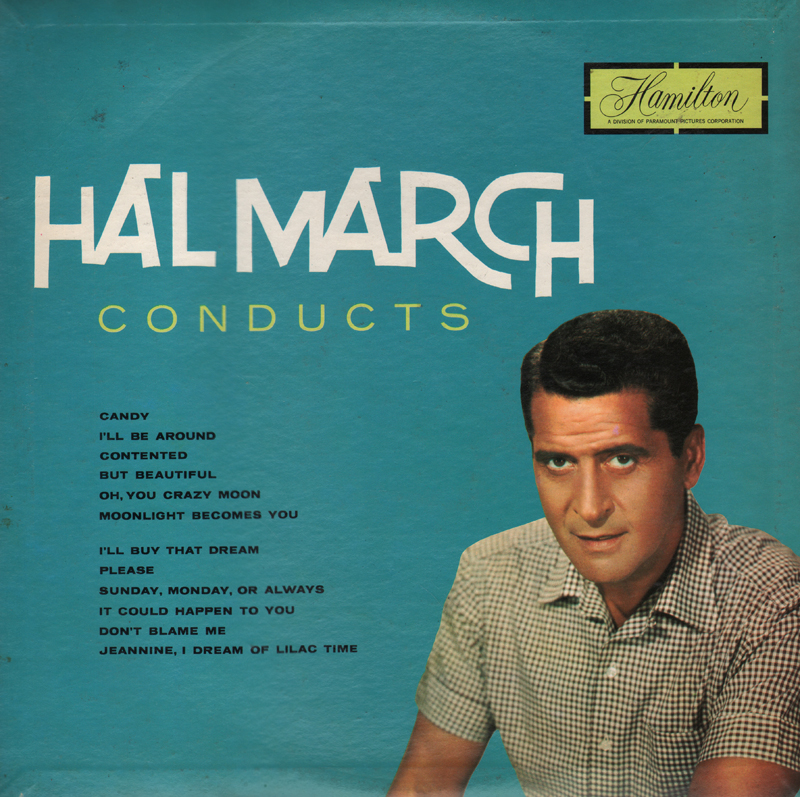
Hal March (Harold Mendelson 1920-1970) was an American comedian, actor as well as accomplished musician and conductor. March began his career in broadcasting as an announcer in San Francisco. After World War II he teamed with Bob Sweeney for The Bob Sweeney-Hal March Show on CBS Radio until 1948. He also appeared in The Adventures of Sam Spade on CBS from 1946-1949. March co-starred as Harry Morton for sixteen episodes of The George Burns and Gracie Allen Show on the NBC and CBS radio networks from the mid-1940s until 1950. When the show switched to television that year, he was replaced mid-season in 1951 by Fred Clark.

March's heyday was the 1950s. His popularity and comedic style cast him in single episodes of many popular shows of the era. The exceptions are four episodes of My Friend Irma and six appearances as himself on The Dennis Day Show. Today, March may be best known for his "guilt by association" with The $64,0000 Question scandal period. Unaware of the producer's and contestant's fraud, his career nevertheless suffered somewhat. In 1961, he played the lead in Neil Simon's first Broadway play Come Blow Your Horn, a hit that ran 677 performances. March finished out his career in 1968, though with fewer television appearances. 

Note: I have found it difficult to uncover much about Hal March's musicianship. In tribute, I have included one of his albums above. 

Thursday, December 1, 2022

A Man of Value


Tom Bergeron was born of French Canadian and Irish descent in 1955. He became a popular radio DJ, playing comedy records along with music and offbeat interviews. One of his first jobs on television was as host of a local game show. Bergeron was always on the move. He landed in Boston's giant, WBZ radio, where he remained through the Eighties. His national television work in the Nineties lead to hosting duties of Hollywood Squares from 1998 to 2004 for which he won a Daytime Emmy Award for Outstanding Game Show Host in 2000. Bergeron had already been host of America's Funniest Home Videos since 2001. He remained there for another fourteen years. He also overlapped duties as host for Dancing with the Stars from 2005 to 2019. Among this non-stop pace, Bergeron had time for acting, appearing on Star Trek: Enterprise and the mystery series, Castle, among others, sometimes as himself. Bergeron is destined to be in demand for many more years.

Tuesday, October 25, 2022

A Household Face


Allan Melvin (1923-2008) was a versatile actor, voice-over artist and a surprisingly good impressionist of some mega-stars of Hollywood's "golden age." He was also adept in “tough guy” roles, further showcasing his range as an actor. The Kansas City native developed a nightclub act and broke into radio winning Arthur Godfrey's Talent Scouts radio show competition. His big break came in 1955 as a regular on The Phil Silvers Show as Corporal Henshaw. He was back in the Army as Sgt. Snorkle in Beetle Bailey, 1963.

Melvin's characters ranged from comical to obnoxious with equal success. He worked extensively with Sheldon Leonard and Aaron Ruben on CBS where he became a household face. Still in the television Army, he had the plum role as Staff Sgt. Hacker on Gomer Pyle, USMC. His devious set-ups with Frank Sutton, aka Sgt. Carter, was a highlight of both characters. He was the "go-to" actor for several episodes of The Dick Van Dyke Show (as an old Army buddy) and The Andy Griffith Show. By this time, Melvin added to a long list of voice-overs for various cartoon characters which continued into the Nineties. 

Melvin is also remembered for supporting roles as Sam Franklin, the owner of a local butcher shop and boyfriend of the Brady's housekeeper, played by Ann B. Davis on The Brady Bunch, and Barney Hefner, Archie Bunker's neighbor and friend on All in the Family.

Pictured above with Melvin is fellow co-star, Ronnie Schell, on Gomer Pyle USMC.

Tuesday, January 18, 2022

Entertaining Renaissance Man


Robert Q. Lewis (Robert Goldberg 1921-1991) was an American entertainer of radio and television, a game show host, commercial pitchman, and part-time actor in film. If that were not enough, Lewis had a very popular nightclub act as singer and comedian. Aside from his wit, he is famously recognized by his bold-rimmed glasses, which became his trademark. In fact, for his second Robert Q. Lewis Show, they became a logo for the show's title card. 

Already a fixture during television's early years, Lewis is perhaps best known today for his game show participation, regularly appearing as a panelist on Goodson-Todman-produced shows. He first settled into his enduring game show role as host of ABC's The Name's the Same (1952-54). Lewis was often recruited to fill in for performers who were ill or otherwise unable to perform. He frequently sat in for Arthur Godfrey, whom Lewis credited for giving him his first big breaks in show business. He hosted and appeared on a multitude of television shows and sitcoms through the 1970s. By far, he was most visible as a panelist on What's My Line? with forty appearances. Lewis had a sketched pair of glasses amusingly applied on his blindfold that was used during the final celebrity guest segment. 

The "Q" was simply part of his professional name. Lewis added the middle initial accidentally on the air in 1942 when referencing another radio comedian's character, Colonel Lemuel Q. Stoopnagle, saying, "and this is Robert Q. Lewis." He retained the unique moniker by telling interviewers that it stood for "Quizzical."

Note: Lewis scored his biggest hit song in 1951 with the Italian dialect humorous novelty song, Where's-a Your House?, (a parody of the Rosemary Clooney hit, Come On-a My House) about a guy who cannot locate Rosie's house. You can hear it here.

Tuesday, July 6, 2021

Everybody Wanted Moore


Garry Moore (Thomas Garrison Morfit 1915-1993) was an American entertainer, comedic personality, humorist and this versatility made him a force to be reckoned with in the 1950s and 1960s. Early in his career, he was recognized distinctly for his bow tie and his crew cut fashion and his on-air transparency. He hosted the hugely popular weekly prime-time panel show, I've Got a Secret, from 1952 until 1964. It was double duty for Moore with his variety series, the hour-long, The Garry Moore Show (1958-64) airing simultaneously. The show was a revival of his earlier 1950 30-minute talk-variety show. He was noted for promoting the careers of other entertainers, most notably, Carol Burnett. Moore later replaced the original host of To Tell the Truth, Bud Collyer, when the show was syndicated from 1969 to 1977. But health trouble resulted in numerous guest hosts during his tenure. After a forty-two-year career, Moore retired in 1977 after announcing on the show about his health. 

Before television, Moore recorded six of his radio monologues for Decca in 1944, including his incredible, triple-time speed reading of Little Ride Riding Hood, his classic “Hugh, the Blue Gnu,” and a calamity-filled version of “In the Good Old Summertime”. They were released as an album of three 78 rpm records titled “Culture Corner”.