Showing posts with label 1970. Show all posts

Thursday, April 6, 2023

Broadcast Pioneers


The Huntley-Brinkley Report
was a trusted news source in the early television years. Having two anchors may have seemed a bad idea but the authoritative style of Chet Huntley, reporting from New York, and David Brinkley, from Washington, DC, proved to be a big success. The program ran fifteen minutes at its inception in 1956 but expanded to thirty minutes in 1963, following the lead of the CBS Evening News with Walter Cronkite. The signature theme music used for the broadcast was by Ludwig van Beethoven with an ending theme being his Symphony No. 9 in D Minor, Op. 125, second movement, of the Ninth Symphony. It was broadcast from a 1952 studio recording conducted by Arturo Toscanini of the NBC Symphony Orchestra.

NBC executives were growing dissatisfied with John Cameron Swayze and the Camel News Caravan. It began falling behind CBS's Douglas Edwards with the News. As a result, Swayze was out and Huntley-Brinkley was in. Huntley handled the bulk of the news most nights, with Brinkley specializing in Washington politics. They possessed a strong chemistry with viewers liking that the anchors talked to each other. In reality, aside from their sign-off, Huntley and Brinkley's only communication came when one anchor finished a story and handed off to the other by saying the other's name, a signal to an AT&T technician to switch the long-distance transmission lines from New York to Washington or vice versa.

By 1965, the program brought in more advertising revenue than any other on television. Critics considered Huntley to possess one of the best broadcast voices ever, and Brinkley's dry, often witty, news writing presented viewers with a contrast to the often sober output from CBS News. NBC producer, Reuven Frank, wrote their closing lines which were for decades one of the most parodied catchphrases on television: "Good night, Chet. Good night, David...and good night, for NBC News." With Huntley's announced retirement, their last news broadcast together was during the summer of 1970.

Note: The 1980s television sketch comedy, SCTV, gave Rick Moranis an opportunity to parody Brinkley with extraordinary comedic accuracy, visually and vocally.

In the image above, the NBC news crew prepares for an oval office interview with President Kennedy (seated) in September 1963. Standing, facing, is Brinkley. To his left in Huntley.

Thursday, February 9, 2023

Twentieth Century Talkers


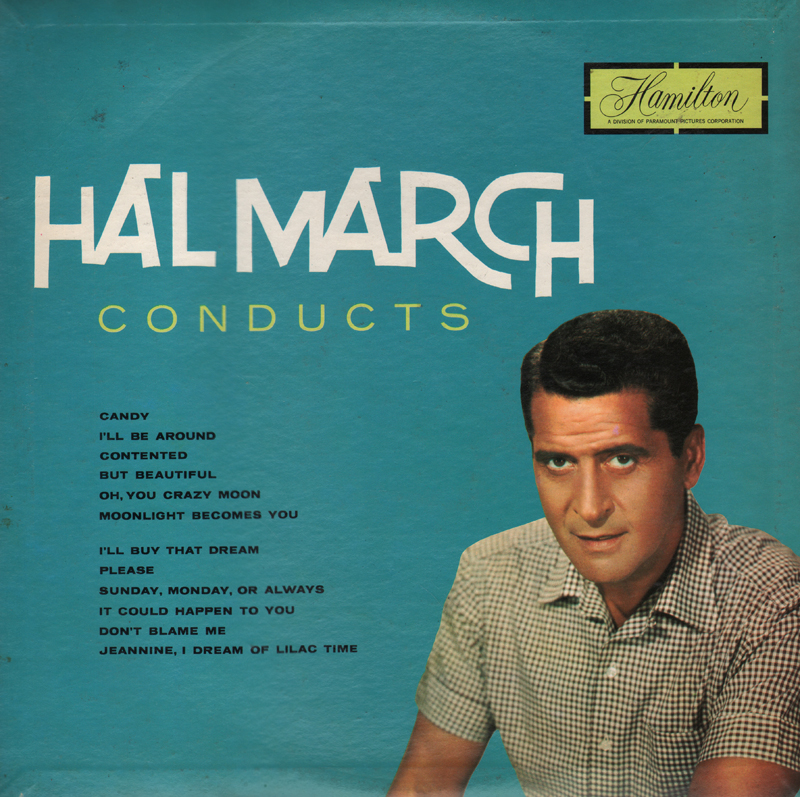
Hal March (Harold Mendelson 1920-1970) was an American comedian, actor as well as accomplished musician and conductor. March began his career in broadcasting as an announcer in San Francisco. After World War II he teamed with Bob Sweeney for The Bob Sweeney-Hal March Show on CBS Radio until 1948. He also appeared in The Adventures of Sam Spade on CBS from 1946-1949. March co-starred as Harry Morton for sixteen episodes of The George Burns and Gracie Allen Show on the NBC and CBS radio networks from the mid-1940s until 1950. When the show switched to television that year, he was replaced mid-season in 1951 by Fred Clark.

March's heyday was the 1950s. His popularity and comedic style cast him in single episodes of many popular shows of the era. The exceptions are four episodes of My Friend Irma and six appearances as himself on The Dennis Day Show. Today, March may be best known for his "guilt by association" with The $64,0000 Question scandal period. Unaware of the producer's and contestant's fraud, his career nevertheless suffered somewhat. In 1961, he played the lead in Neil Simon's first Broadway play Come Blow Your Horn, a hit that ran 677 performances. March finished out his career in 1968, though with fewer television appearances. 

Note: I have found it difficult to uncover much about Hal March's musicianship. In tribute, I have included one of his albums above. 

Friday, January 22, 2021

The Jumbo Era Begins

On this day in 1970, Captain Robert Weeks, Captain John Noland and Flight Engineer August McKinney flew the Pan American World Airways Boeing 747-121, N736PA, Clipper Young America, arrived in London from New York for its six-hour, fourteen-minute maiden transatlantic flight of the new jumbo jet. Aboard was a cabin crew of 17 and 332 passengers. London Airport services were geared to deal as quickly as possible with the passengers and 30,000 pounds of baggage and cargo aboard. Loading delays dealing with the large aircraft, coming and going, did not concern most passengers but a few selected other options for their return to New York.

Earlier this year, Boeing announced that the final 747s, four 747-8F freighters, had been ordered by Atlas Air Worldwide Holdings, Inc. When they have been built, the production of the “jumbo jet” will come to a close.