Showing posts with label actor. Show all posts

Wednesday, April 8, 2026

Synopsis: Bewitched by Television

Some film actors found steady work and more exposure with the advent of television. 


Dick York (1928-1992)

For those who remember actor Dick York, he has been pigeon-holed as Darrin Stephens, the mortal, suffering husband of Samantha on the fantasy-comedy series, Bewitched (1964-69). His comedic double-takes, being frequently frustrated, and often angry with the physical transformations thrust upon him by his ungrateful mother-in-law, were classic trademarks of the character. Without his perfect comedic timing, the series would not have been the hit that it was. But there was much more to the versatile actor.

Born in Fort Wayne, Indiana, and growing up in Chicago, Dick York eventually handled drama and comedy with equal ease. After a stint in radio, his movie roles gained momentum by 1950, and four years later, he was cast as a teenager in the classic science fiction film, Them!. He co-starred in three famous movie productions in the Fifties and Sixties, notably They Came to Cordura (1959) with Gary Cooper, The Last Blitzkrieg that same year with Van Johnson, and a visible role as a teacher for Inherit the Wind a year later.

By far, his television work brought the most notoriety, however. He performed on the most popular series of the era. There were multiple appearances on the Kraft Television Theatre, Studio One, Playhouse 90, The Twilight Zone, and six episodes for Alfred Hitchcock Presents that provided some comedic and dramatic stand-outs. 1959 was a pivotal year for York. While filming the Cooper film above, he completely severed his right lower back muscles during a physical scene. An injury that would plague him the rest of his life, and eventually force him to bow out of Bewitched in 1969.

Note: Before television dominated the airwaves, radio reigned supreme. The above inset is a capture of fifteen-year-old Dick York in the situation comedy, “That Brewster Boy” (1941-45). York was the third Joey Brewster, following in Eddie Firestone Jr. and Arnold Stang's footsteps. To his right is co-star Jane Webb.

Tuesday, November 11, 2025

Casting Needs and Leeds


Peter Leeds (1917-1996) was a jack-of-all-trades American actor who had the distinction of appearing more than 8,000 times on television and heard on over 3,000 radio shows. The actor was a "household face" to the parents and their Baby Boomers during the 1950s and 1960s. In spite of his leading man looks, his work was mostly uncredited, filling needed roles in films of the 1940s and being the straight man for many well-known television comedians for three decades. The 6'1" Leeds was also a dramatic actor and Broadway performer who stayed active into the 1980s. 

On my other site, Forgotten Cinema, I select mostly unknown or obscure movies, highlighting commendable or poor production values, the actors' performances, the dialogue, and the music score, usually with humor. Leeds appeared in seven films (below) that I have reviewed, yet his brief appearances elicited little, if any mention, because his role was not significant to the overall story. The exceptions might be 99 River Street or High School Bigshot. As always, Leeds had a genuine style that brought realism to his roles, despite being included in some inferior films. 

1949    D.O.A.     Leo, a bartender
1950    Dial 1119     Martin, a policeman
1953    99 River Street     Nat Finley
1954    The Atomic Kid      Agent Bill
1956    Behind The High Wall     Detective
1957    Bombers B-52     TV quiz show director
1959    High School Big Shot     Carter, a teacher

Wednesday, November 13, 2024

Synopsis: Thrust Into Television

Many movie character actors found steady work and arguably more exposure with the advent of television. 


FRANK FERGUSON (1899-1978)

Frank Ferguson was a character actor who made his film debut in 1940. In that decade, he appeared in modern-day dramas as a detective, a father, and a reporter, as well as being cast in the occasional comedy. Based on his distinct barrel voice, his ever-present mustache, and an everyman's face, Ferguson was a natural in Western films, nearly two hundred. A few of those are quite notable, but Ferguson was often uncredited. He could play anything from an outlaw, a sheriff, a disgruntled farmer, or a friendly, though maybe dishonest, store clerk. He was a very valuable and natural performer whom many directors found a character worthy of his talents. 

However, the bespectacled actor was most seen from his frequent television appearances over twenty-plus years. In a wide variety of roles, Ferguson was often a public servant. He might be a doctor, a military officer, a bank teller, a police officer, or a businessman. With little surprise, he even played a hobo on the Leave It To Beaver comedy. He was the familiar face of many popular dramas, and of course, nearly every television Western. His final appearance was on the pioneer era series, Little House on the Prairie, in 1976.

Wednesday, September 11, 2024

Synopsis: Thrust Into Television

Many movie character actors found steady work and arguably more exposure with the advent of television. 


BARTLETT ROBINSON (1912-1986) 

Robinson was an American actor who performed on radio, stage, film, and television for five decades. The mustachioed Robinson and his recognizable voice were often cast in mostly serious roles of authority, such as military officers, wealthy ranchers, sheriffs, corporate executives, doctors, and judges, whether in Westerns, dramas, or playing the straight man in comedies.

Wednesday, July 31, 2024

Synopsis: Thrust Into Television

Many movie character actors found steady work and arguably more exposure with the advent of television. 


BEN COOPER (1933-2020) 

Though not a household name, Ben Cooper always provided a convincing performance with intensity and pathos. The American actor can be found in numerous supporting roles in films and the occasional lead in lower-budget projects. His modern-day dramas are probably lesser known. Cooper was most associated with the Western film, yet never strayed far from the television path, however. Her was a natural in Westerns, partly due to his horseman skills that began during his childhood. 

Discover more about Cooper's career at IMDB.

Friday, July 19, 2024

Synopsis: Thrust Into Television

Many movie character actors found steady work and arguably more exposure with the advent of television. 


MICHAEL PATE (1920-2008) 

Michael Pate was an Australian actor, writer, director, and producer, better known for his prolific work as a supporting actor in Hollywood films and American Television during the 1950s and 1960s. His range of characters spanned the globe. Though with only a slight variation of an accent, he may be most familiar as an American Indian, a Turkish ruler or guide, or an Eastern European spy or assassin. As a guest star, he played villains in American television comedies, including Batman (1966).

After serving during World War II, Pate had a brief acting career in his native country before heading to Hollywood in the 1950s. He appeared in over 300 television shows and films, including his most distinct introduction in 1954 for a
Climax! live production of Ian Fleming's Casino Royale. Pate played the role of "Clarence Leiter," opposite Barry Nelson's "Jimmy Bond." Two years later, he was cast in a supporting role in Danny Kaye's masterpiece comedy, The Court Jester. Numerous sources list all his films, some of which are notably famous.

During his time in the United States, Pate became an acting instructor and lecturer, and wrote many screenplays and plays for American films and television series. He appeared in nearly all the popular television Westerns during the decade as well as many adventure shows, before returning to Australia to become a television producer, winning two Logie Awards for his efforts. Pate retired in 2001 but kept busy doing voice-over work and writing screenplays.

Wednesday, June 19, 2024

Synopsis: Thrust Into Television

Many movie character actors found steady work and arguably more exposure with the advent of television. 


MYRON HEALEY (1923-2005) 

Healey's characters may be despised more than others in film or television during the 1950s, thanks to his condescending delivery as a villain. When Healey was "bad," he could be despicable. He somewhat carried the torch from actor Harry Lauter, nine years his elder. He appeared in some 140 films, including more than 80 westerns, frequently for Monogram Pictures. But it was television that brought him intimate exposure. Healey served in World War II as an Air Corps navigator and bombardier, flying in B-26 Martin Marauders in the European Theatre. After the war, he continued military duties, retiring in the early 1960s as a captain in the United States Air Force Reserve.

Discover more about Healey's career at IMDB.

Thursday, February 29, 2024

A Leap-Year Bonus


REEL CHARACTER SERIES

Clinton Sundberg (1903-1987) was an American character actor of stage and supporting roles in film. He was most visible from the mid-forties through the mid-fifties before turning primarily to television appearances throughout the Sixties. The soft-spoken, raspy tenor portrayed various desk clerks, waiters, butlers, and menservants with subtle comedic results, often with decidedly snippy or sarcastic opinions. On the small screen, he got bigger, with assertive roles in the likes of doctors or professors.

In his humorous initial scenes, Sundberg is shown with Gary Cooper in the film, Good Sam (1948).

Wednesday, July 12, 2023

Television's Leon Friedman


Lee Philips (Leon Friedman, 1927- 1999) was a prolific American actor and film and television director. The New York City-born Philips' acting career started on Broadway, which led to a starring role in the film adaptation of Peyton Place. The handsome actor possessed versatility and intensity in his roles. His most visible presence was in television, guest-starring in numerous popular shows from the early Fifties through the Seventies. His credits include The Fugitive, The Outer Limits, The Twilight Zone, and I Spy, among many others. He guest-starred in a few series that he would also direct at some point. His twelve appearances as the title character in 1959's The Further Adventures of Ellery Queen were his longest. 

By the early to mid-Sixties, his career included directing, with a wide range of television credits including Peyton Place, The Ghost and Mrs. Muir, Room 222, and The Waltons, to name a few. As a director, Philips and Dick Van Dyke worked together numerous times, beginning with The Dick Van Dyke Show, The New Dick Van Dyke Show, and Diagnosis Murder. By far his longest tenure as director was his sixty episodes of The Andy Griffith Show. In between, he directed several television movies throughout the Seventies and Eighties.

Tuesday, June 13, 2023

A Natural Talent


Frank Overton (1918-1967) was an American actor of stage, film and television. He had the ability to project an air of authority into his diverse roles with a countenance and pointed vocal delivery. He is well known for the roles as Sheriff Heck Tate in To Kill a Mockingbird (1962) and General Bogan in Fail Safe (1964).

But Overton is best known for his many television roles from the early 1950s through the 1960s, from Westerns to contemporary dramas. In a standout episode, he appeared in an episode of The Twilight Zone with Gig Young, called "Walking Distance" in 1959 (pictured above with Gig Young). His sensitive and compassionate portrayal anchored his character in reality. Other work included The Fugitive, 1963, and two guest appearances on the drama series Perry Mason playing a priest and a deputy. Overton appeared six times on The United States Steel Hour and in four episodes of Route 66. In ideal casting, he played Major Harvey Stovall in the series Twelve O'Clock High. One of his last television roles was on a Star Trek episode in 1967. The entertainment world lost a great talent much too soon.

Tuesday, May 9, 2023

The Aubuchon Way


Jacques Aubuchon (1924-1991) was an American character actor who kept busy from the 1950s through the 1980s. He is primarily known for his roles in a wide variety of television series.

Though Aubuchon spent most of his career on the small screen, he was in a handful of films, including Beneath the 12-Mile Reef (1953), The Silver Chalice (1954), and Thunder Road (1958) to name three. His roles varied from Westerns to modern-day dramas to comedies. His first television appearance was on the comedy Mr. Peepers (1953). He could play an informant, an outlaw, or a criminal. He somewhat specialized in untrustworthy individuals, even in comedies. His mastery of dialects made him a popular casting choice. Aubuchon perhaps is best known for his seven appearances on the wacky comedy McHale's Navy (1962-64) as the hilarious Chief Urulu.

Above, left is Jacques Aubuchon with actor J.D. Cannon 

Tuesday, May 2, 2023

You Be The Judge, Mr. Quinn


Bill Quinn
(1912-1994) was an American film and prolific television actor. He appeared in more than 150 roles over seven decades, starting in the 1920s in silent films. He was the father-in-law of comedy legend, Bob Newhart.

The versatile Quinn acquitted himself in every role, whether uncredited or supporting in dramas or comedies. Viewers could often find him in court as a judge, in a police uniform, or in other service-related occupations. It is his television appearances that brought him the most attention. By far it was his thirty-eight appearances as a cast member on The Rifleman as Frank Feeney and eighty-eight appearances on Archie Bunker's Place as a blind patron. Though his single appearances are too numerous to chronicle here, his other multiple guest star roles in a series include, Wanted: Dead or Alive, Perry Mason, Hawaiian Eye, McHale's Navy, Bonanza, Ironside, as the father of Mary Richards for The Mary Tyle Moore sitcom and four various roles on The Rockford Files. True to form, Quinn played Judge Tomlinson on Owen Marshall, Counselor at Law, and as Judge Tesman on Arrest and Trial. 

Friday, April 28, 2023

Hefty Baritones


Starting from left are baritones, Edward Arnold (Gunther Edward Arnold Schneider 1890-1956) and his heavyweight "successor" Robert Middleton (Samuel G. Messer 1911-77) on the right. Both could play criminals, wealthy bankers, or landowners in comedies or dramas. Sometimes mean, sometimes likable. Arnold missed the television era but was famous for his numerous first-rate films in the 1930s and 1940s. Although Middleton had a few motion pictures under his belt, he was most visible on the small screen in a wide variety of roles for nearly twenty-five years starting in the 1950s.

Tuesday, April 25, 2023

When the Uniform Fits


William Boyett (1927-2004) was an American actor best known for his television roles in law enforcement dramas on television. Aside from a handful of uncredited film roles early in his career, he was a mainstay of television from the 1950s through the 1990s. The handsome actor was known for his tight, frontal baritone vocal delivery and looking right at home in a uniform.

Harry William Boyett was born in Akron, Ohio, and showed an interest in theater at a young age. He won a Shakespeare competition in high school, which led to acting jobs in radio. After his service in the Navy during World War II, he performed on the stage in both New York City and Los Angeles. By the mid-Fifties, his career was jump-started with recurring roles in over sixty-five episodes of Highway Patrol. Boyett also portrayed a policeman in such diverse series as Bat Masterson; Batman; and Star Trek: The Next Generation. He had roles on Sea Hunt in ten episodes, eight episodes of Perry Mason, and nine episodes of Dragnet 1967. But by far his most visible role was as Sgt. "Mac" MacDonald on 129 episodes of Adam 12.

Through the 1960s and 1970s, Boyett found steady work on such diverse series as Laramie, I Spy, The Andy Griffith Show, Fantasy Island, The Love Boat, The Rockford Files, Gunsmoke, Emergency!, Knight Rider, Murphy Brown, and Night Court. Boyett's final visible role, not surprisingly as a desk sergeant, ended his career on a low note in the direct-to-video live-action comedy, Theodore Rex (1995).

Tuesday, March 21, 2023

Man With A Niche


Peter Whitney (Peter King Engle 1916-1972) was an American actor in many Hollywood films in the 1940s and 1950s. His career started at the beginning of the Forties with a supporting role in
Action in The North Atlantic, opposite Humphrey Bogart, and Destination Tokyo, starring Cary Grant, both films released in 1943. He kept busy throughout the Forties but the television medium beckoned. 

Whitney may be most visible on the small screen as the tall and increasingly heavier brute from more than twenty years of playing narrow-minded villains or slow-witted characters on countless television series. In general, if one could name a popular series during the Fifties and Sixties, Whitney was probably cast in them to one extent or the other. From his many westerns to crime dramas and comedies, he always made an impact on a wide variety of ethnic characters. His final role was for Rod Serling's Night Gallery in 1972. 

Tuesday, February 28, 2023

Hidden in Plain Sight


Jason Evers (1922-2005) was an American actor on stage, in film, and on television. The handsome actor often portrayed ill-fated characters. Despite consistent, strong supporting roles, he seemed hidden "in plain sight" by his fellow lead actors. Roles on Broadway led to Hollywood, with one of his earliest television multi-role characters on the hit comedy The Phil Silvers Show. His first recurring role was on the 1960 NBC Western series Wrangler. Evers made three appearances on Perry Mason before Evers starred as Professor Howe in the 26-episode ABC drama series Channing (above), based on life at Channing College and not his character's name. His most infamous role and first film is from the 1959 B-movie, The Brain That Wouldn't Die, released in 1962. Fortunately, he redeemed himself in two big-budget sci-fi films, The Illustrated Man (1969) and Escape from the Planet of the Apes (1971). Evers appeared in thirteen episodes of The Guns of Will Sonnet (1967). By 1970, Evers turned up on many television series, ranging from The Doris Day Show, The Streets of San Francisco, The Rockford Files, and many others through the 1980s. 

Thursday, February 9, 2023

Twentieth Century Talkers


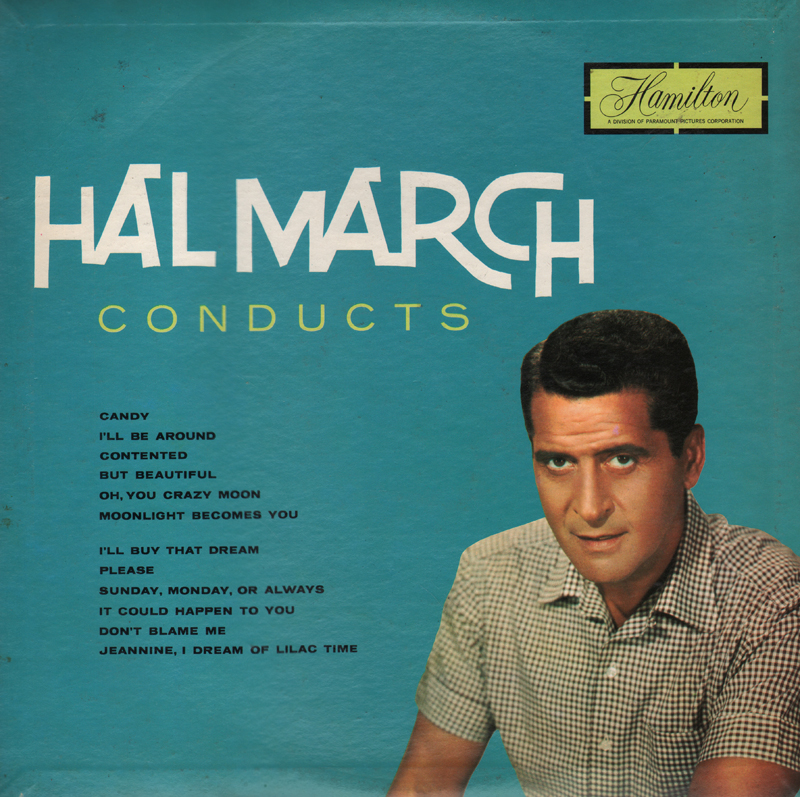
Hal March (Harold Mendelson 1920-1970) was an American comedian, actor as well as accomplished musician and conductor. March began his career in broadcasting as an announcer in San Francisco. After World War II he teamed with Bob Sweeney for The Bob Sweeney-Hal March Show on CBS Radio until 1948. He also appeared in The Adventures of Sam Spade on CBS from 1946-1949. March co-starred as Harry Morton for sixteen episodes of The George Burns and Gracie Allen Show on the NBC and CBS radio networks from the mid-1940s until 1950. When the show switched to television that year, he was replaced mid-season in 1951 by Fred Clark.

March's heyday was the 1950s. His popularity and comedic style cast him in single episodes of many popular shows of the era. The exceptions are four episodes of My Friend Irma and six appearances as himself on The Dennis Day Show. Today, March may be best known for his "guilt by association" with The $64,0000 Question scandal period. Unaware of the producer's and contestant's fraud, his career nevertheless suffered somewhat. In 1961, he played the lead in Neil Simon's first Broadway play Come Blow Your Horn, a hit that ran 677 performances. March finished out his career in 1968, though with fewer television appearances. 

Note: I have found it difficult to uncover much about Hal March's musicianship. In tribute, I have included one of his albums above. 

Tuesday, February 7, 2023

Big Small Screen Presence


Tim O'Connor (1927-2018) was an American character actor known for his steady work in television until the 1990s. By far, O'Connor's 416 appearances as Elliot Carson on Peyton Place were his most appearances on a single show. Another well-known role was playing Dr. Elias Huer in Buck Rogers in the 25th Century. Other recurring roles were on Barnaby Jones, Dynasty, The Streets of San Francisco, Cannon and six episodes of The F.B.I. O'Connor's voice and physical presence allowed him to specialize in playing various officials, physicians, military men, and police officers. Like one of his peers, David Janssen, O'Connor made a bigger impact on the small screen than in films. O'Connor's film appearances were sparse. A few include The Groundstar Conspiracy (1972), Across 110th Street (1972), Sssssss (1973), and The Naked Gun 2½: The Smell of Fear (1991). His last performance was in the film, Dreams Awake (2011) where he reunited with Erin Gray from their Buck Rogers series.

Tuesday, January 3, 2023

Television Transition


Jack Hogan (1929 -)

The television medium offered a logical career move away from low-budget movies, keeping them quite busy and in demand.


Jack Hogan (Richard Roland Benson Jr.) is an American actor most notable for his recurring roles on two hit series, Adam-12, and Combat! His interests have included painting, fishing, reading, and poetry since retirement.

The Chapel Hill-born Hogan studied architecture at the University of North Carolina before enlisting in the Korean War. He studied drama at the Pasadena Playhouse and in New York after his hitch was up. Hogan's acting career was established on the small screen but he massaged in five films during the mid-Fifties, with a "best-of" performance as The Cat Burglar (1961). Hogan made supporting appearances on nearly every popular television show in a variety of roles from the Fifties into the Nineties, always with a genuine, believable delivery. His most visible role, however, was his 111 episodes of the five-season hit drama, Combat!, above as PFC William G. Kirby. Most may not know he was a casting director for another hit show, Magnum, P.I.

Thursday, December 22, 2022

Television Talkers


As an aspiring actor and opera singer, Gene Rayburn (Eugene Peter Jeljenic, 1917-1999) made the move to New York City but was unable to find stage work. He landed a job as an NBC Studios page and tour guide at 30 Rockefeller Plaza. Before television fame, Rayburn was a radio performer, announcing at various radio stations before enlisting in the United States Army Air Forces during World War II. He chose the stage name "Rayburn" by randomly sticking his finger in the phone book.

Making use of his talent, Rayburn took the lead role in the Broadway musical Bye Bye Birdie after Dick Van Dyke left to star in The Dick Van Dyke Show. He began a long association with game show producers Mark Goodson and Bill Todman in 1953. After hosting several game shows, he hit pay dirt with The Match Game in 1962-1969. The show was revived in 1973 simply as Match Game and ran for another decade. During this time one of Rayburn's trademarks was his long, skinny microphone that he was able to hold near his waist. 

Note: Rayburn's last game show hosting duties were on Break the Bank in 1985.