Showing posts with label 1929. Show all posts

Wednesday, January 8, 2025

First In Color. With Help.


Admiral Corporation Inc. is best known worldwide for its home appliances and electronics. The company was originally known as the Transformer Corporation of America, and by 1929, it was the biggest supplier of radio parts in the world. The Great Depression took its toll, and Ross Siragusa, the founder, was forced to declare bankruptcy. Later in 1934, he purchased the “Admiral” trademark, which officially became Admiral Corporation America Inc. in 1936.

Admiral’s global operations started in 1946 with the opening of its factory in Toronto, Canada, with subsequent regional entities in Mexico, Italy, Taiwan and India. In 1952, the U.S. National Television Systems Committee (NTSC) set a goal of creating an “industry color system.” At the end of 1953, Admiral introduced their first electronic color television system, the C1617A (pictured above), using a 15-inch tri-color 15GP22 CRT and other components by RCA. Sales were understandably dismal for $1,175 (over $13,000 today), a limited production run, and no color broadcasting. It would take about a decade for color sets to become profitable. By 1966, the company had a staff of over 14,000 with operations in 110 countries, and overall sales revenue skyrocketed to $414 million.

Acquired by Rockwell International in 1973, its appliance division was sold to Magic Chef, Inc., which was then acquired by the Maytag Corporation in 1986.  Whirlpool Corporation acquired Maytag in 2006. Under Whirlpool, the Admiral brand became exclusive to The Home Depot. During the 1990s, the Admiral brand name was being used on Zenith products, and for Montgomery Ward as well as VCRs made by Sharp. The television business continues with AOC International, originally Admiral Overseas Corporation, an international brand of LCD and HDTV display devices.

Wednesday, November 8, 2023

Mr. Kerr and Mr. McGee


The Kerr-McGee Corporation was an American energy company involved in oil exploration, production of crude oil, natural gas, perchlorate, and uranium mining and milling in various countries. Anadarko Petroleum acquired Kerr-McGee in 2006, itself being acquired by Occidental Petroleum in 2019.

Founded in 1929 as Anderson & Kerr Drilling Company by Oklahoma businessman-politician Robert S. Kerr (1896-1963) and oil driller James L. Anderson, its name was changed to Kerr-McGee Oil Industries, Incorporated after Dean McGee (1904-1989) joined the firm in 1946. The company initially focused mostly on off-shore oil exploration and production and was one of the first companies to use drillships. Beginning in the early 1950s, Kerr-McGee was involved in several nuclear endeavors. The 1957 illustration above would seem to catapult off these explorations. The sub-heading about landing on the moon turned out to be an accurate prediction.

Thursday, June 1, 2023

Permanently Numbered


In 1929 the New York Yankees became the first major league baseball team to make numbers permanent on the backs of their jerseys. The numbers were handed out based on the batting order in the lineup. Babe Ruth was the first Yankee to hit a home run in a stylish new number-plated #3 jersey. But the Yankees have never had names emblazoned on their uniforms. The one exception was the 2017 MLB Players Weekend which used nicknames on special jerseys. MLB has been making money ever since. A 2010 opinion about the uniforms here.

Thursday, March 9, 2023

Bib-Label Lithiated Lemon-Lime Soda


Seven-Up (7up) was created by Charles Leiper Grigg, who was introduced to the carbonated beverage business early in his career. Grigg had invented two orange-flavored soft drinks, but it was literally crushed by the dominance of the king of all orange pop drinks, Orange Crush. Grigg shifted his focus to a lemon-lime formula. Originally named "Bib-Label Lithiated Lemon-Lime Soda", it was launched two weeks before the Wall Street Crash of 1929. Its name was later shortened to "7 Up Lithiated Lemon Soda" before being further shortened to just "7 Up" by 1936. Until the government ban in 1948, the original formula contained lithium citrate, which was used in various patent medicines at the time for improving moods. It had been used for many decades to treat manic depression, one of a number of patent medicine products popular in the late-19th and early-20th centuries. The drink was neither lost on the 1929 stock market crash nor the drummer above. 

The origin of the revised name is unclear. Lithium was one of the elements with an atomic number of 7, while others have suggested the name came from the use of 7-ounce bottles when most other soft drinks were bottled in 6-ounce bottles. Grigg never explained the name but did promote 7up as having effects on mood. Another problematic ingredient was Calcium Disodium EDTA which was removed in 2006. 

Note: Westinghouse took over 7up in 1969, then sold it to Philip Morris in 1978. The investment firm Hicks & Haas bought it in 1986 with 7up merging with Dr. Pepper in 1988. Now a combined company, it was bought by Cadbury Schweppes in 1995. A popular ad campaign in the 1970s labeled the drink the "Uncola."

Tuesday, January 3, 2023

Television Transition


Jack Hogan (1929 -)

The television medium offered a logical career move away from low-budget movies, keeping them quite busy and in demand.


Jack Hogan (Richard Roland Benson Jr.) is an American actor most notable for his recurring roles on two hit series, Adam-12, and Combat! His interests have included painting, fishing, reading, and poetry since retirement.

The Chapel Hill-born Hogan studied architecture at the University of North Carolina before enlisting in the Korean War. He studied drama at the Pasadena Playhouse and in New York after his hitch was up. Hogan's acting career was established on the small screen but he massaged in five films during the mid-Fifties, with a "best-of" performance as The Cat Burglar (1961). Hogan made supporting appearances on nearly every popular television show in a variety of roles from the Fifties into the Nineties, always with a genuine, believable delivery. His most visible role, however, was his 111 episodes of the five-season hit drama, Combat!, above as PFC William G. Kirby. Most may not know he was a casting director for another hit show, Magnum, P.I.

Friday, August 5, 2022

Locomotive Salesman


Tom Fawell (1929-2019) dazzled a generation with his colorful, rakish artwork depicting Electro-Motive Division diesel locomotives on the move. Indeed, he was EMD's illustrator of choice from the early 1960s to 1980. Many of his paintings were featured as the center spread in Fortune Magazine for 25 years. He wanted to portray the feeling of the dynamic power created by a locomotive. His first submission was literally laughed at by the execs, sighting no wheels and the engine appears to be tipping over. But Chicago-based ad agency, Marsteller, convinced GM to run a test and follow up with a readership poll. The results were so favorable that they were ranked "off the charts."

Fawell attended the Chicago Art Institute and later graduated with honors from the Pratt Institute in Brooklyn, New York, in 1953. 

Click or poke the image for a large view.

Thursday, June 23, 2022

The Cloverleaf Interchange


A cloverleaf interchange is a two-level interchange in which all turns are handled by slip roads. This makes them well-suited for the intersection of two freeways. The cloverleaf possesses advantages such as linking ramps safely in order to accommodate left turns. Many cloverleafs today have been highly modified into a complex maze of overpasses in some sprawling cities. 

Though the first cloverleaf interchange was patented in the United States in 1916 by Arthur Hale, a Maryland civil engineer, the first, Woodbridge Cloverleaf, did not open until 1929 at the intersection of the Lincoln Highway, Route 25 and Amboy, Route 4 in Woodbridge Township, New Jersey. Those highway routes have long since been renumbered. The first cloverleaf west of the Mississippi River opened in 1931 at Watson Road and Lindbergh Boulevard near St. Louis, Missouri, as part of an upgrade of Route 66, which utilizes the bridge in the above photo.

Thursday, December 16, 2021

A Noted Television Composer


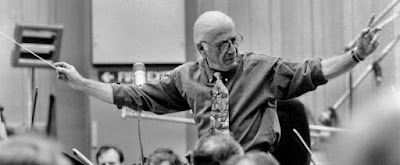
Jerry Goldsmith (Jerrald King Goldsmith 1929-2004) was an American composer and conductor known for his vast work in the film industry but also for television scoring and concert works. He composed scores for five films in the Star Trek franchise and three in the Rambo franchise, as well as for Logan's Run, Planet of the Apes, Patton, Chinatown, Alien, Poltergeist, Gremlins, Hoosiers, Air Force One, and many others. His 1997 opening fanfare for Universal Pictures debuted with the release of The Lost World: Jurassic Park. His silver screen compositions continued into the Twenty-first Century. "Among his many other works" is synonymous with Goldsmith. His film scores were not always identified with him, ranging from light and melodic to very dissonant scores in a style where the melody is nearly non-existent, like many of his influences of early 20th-century composers.

Goldsmith found early work at CBS in 1950 as a clerk typist in the network's music department under director Lud Gluskin. There he began writing scores for radio shows, later progressing into scoring live CBS television anthology series. As the decade progressed, he scored multiple episodes of the television series The Twilight Zone and Dr. Kildare. Goldsmith composed the theme for The Man from U.N.C.L.E. in 1964 and later added his touch to the James Bond parody, Our Man Flint, 1966, and its sequel In Like Flint, 1967. His military/action flare with snare drums was sometimes a giveaway during this period. His most notable television theme in the Nineties was the theme for the UPN series Star Trek: Voyager in 1995. He won a Primetime Emmy Award for Outstanding Main Title Theme Music. It is the most beautifully constructed theme of any Star Trek television series. His score and theme for Star Trek: The Motion Picture, 1979, was later used on the popular television series, Star Trek: The Next Generation in 1987 with an arrangement by Dennis McCarthy.

Note: Goldsmith was good friends with fellow composer, Morton Stevens, of Hawaii Five-O theme fame. Stevens also wrote the theme to television's Police Woman. Goldsmith confessed he used that theme for his Derek Flint character film series. He turned Steven's theme "inside-out" but the melody is lifted intact. Both composers were amused by the reuse.

Thursday, November 11, 2021

A Noted Television Composer


Artie Kane (Aaron Cohen 1929- ) is an American pianist, film score composer, and conductor with a career spanning over six decades. Kane composed the music for over 250 television shows including Wonder Woman, Vegas, Hotel, Dynasty, Matlock, A Question of Guilt, and Man Against the Mob. During his career, he conducted over sixty motion pictures at MGM, Disney, Universal, Fox, Warner Brothers, Sony, and Paramount.

Of special note was his Music Supervisor position on the first season of The Rockford Files. His chosen music for Rockford in his Firebird was unique for the series. Originally a ninety-minute episode, This Case is Closed (1974), is perhaps the best example. Rockford is staking out a suspect as an inventive heavy percussion score adds tension. As the chase begins, the brass and woodwinds kick in as the stunt driver and Garner speed through a residential neighborhood at a realistic pace. Kane's jazzy, seemingly Lalo Schifrin-inspired music during the chase, was, to my knowledge, never used again. 
The music chosen for the series was never the same after his tenure with the series eventually repeating the same music cues when the Firebird was in motion.

Thursday, July 15, 2021

An Unavoidable Bottleneck


A cloverleaf interchange is a two-level interchange common in the United States for over forty years as the Interstate Highway System expanded rapidly. In 1929, the first cloverleaf interchange built in the United States was the Woodbridge Cloverleaf at the intersection of the Lincoln Highway (Route 25) and Amboy—now St. Georges—Avenue Route 4—now U.S. 1/9 and Route 35in Woodbridge Township, New Jersey. The first cloverleaf west of the Mississippi River opened in 1931, at Watson Road and Lindbergh Boulevard near St. Louis, Missouri, as part of an upgrade of Route 66. The primary drawback of the classic design of the cloverleaf is that vehicles merge onto the highway at the end of a loop immediately before other vehicles leave to go around another loop, creating conflict known as weaving. Weaving limits the number of lanes of turning traffic. Most road authorities have since been implementing new interchange designs with less-curved exit ramps.

Thursday, February 11, 2021

The Royal Gorge Bridge (1929)


The Royal Gorge Bridge and Park is a tourist attraction near Cañon City, Colorado that spans the gorge 956' above the Arkansas River. It held the record of the highest bridge in the world from 1929 until 2001. It remains the highest bridge in the United States. The 1,260-foot long bridge is primarily for foot traffic but service vehicles, and in special circumstances, automobiles and motorcycles are allowed. A walk across the bridge can be a bit unsettling as construction allows it to sway.

The project was financed by Lon P. Piper, president of the Royal Gorge Bridge and Amusement Company of San Antonio, Texas. It was built in six months at a cost of $350,000, over 20 million in today's dollars. An Incline Railway was added in 1931 to reach the bottom of the gorge. Most of the park structures on both sides of the gorge were destroyed by a wildfire in 2013. The bridge only needed minor repair and the park's buildings were rebuilt and reopened in a little over a year.