Thursday, August 21, 2025

Bazooka Joe


Bazooka is an American brand of bubble gum that was introduced in 1947. It is a product of Bazooka Candy Brands (BCB), which was a division of The Topps Co. until the latter’s acquisition by Fanatics, Inc. in 2022. By 2023, Apax Partners acquired BCB and its product portfolio.

Back in 1953, the individually wrapped pieces of Bazooka bubble gum featured a comic strip inside and the character, Bazooka Joe. The kid's black eyepatch gave him a singular appearance. Joe is joined in his various misadventures by a motley crew of six characters. The comics generally consisted of child-friendly jokes, as well as small advertisements for overly eccentric merchandise one could obtain in exchange for comics and a few cents or dollars. Over the decades, Bazooka Joe's illustration style and mode of dress changed to keep up with the times. 

The Bazooka gum was most likely named after the rocket-propelled weapon of the same name developed by the U.S. Army during World War II, which was named after an earlier musical instrument used by radio comedian Bob Burns. He is credited with inventing the crude metal instrument in the 1910s and popularizing it in the 1930s. The instrument had a low-register PVC pipe sound that felt right at home with Spike Jone's City Slickers band.

Tuesday, July 29, 2025

Slide Soap


Lava is a heavy-duty hand cleaner in soap bar developed in 1893 by the William Waltke Company of St. Louis, Missouri. Procter & Gamble acquired the Lava and Oxydol brands in 1927. In 1995, P&G sold the Lava brand to the Block Drug Company, a pharmaceutical company based in Jersey City, New Jersey, that specialized in dental care products. Its two most popular products included Polident denture cleanser and Poli-Grip denture adhesive. By 1999, the WD-40 Company bought the Lava brand from Block Drug.

Unlike typical soap bars, Lava contained ground pumice, which gave the soap its name. The soap and pumice combination is intended to scour tar, engine grease, paint, dirt, grime, filth, and similar substances from the skin. The original beige-colored Lava bar soap, without moisturizers, is no longer manufactured.

Note: The word lava comes from Italian and is likely derived from the Latin word labes, which typically refers to a disaster, downfall, landslip, or slide.

Tuesday, July 8, 2025

Acting for Beans

Below are four Hollywood personalities (and one dummy) who served as spokespersons for four popular coffee brands from the 1930s through the 1970s.

Virginia Christine
San Francisco's Pioneer Steam Coffee and Spice Mills was the original name behind Folgers of 1850. Employed as a teenager, James A. Folger eventually became a full partner in the company by 1865. By 1972, Folger bought out the partners and renamed the company, J.A. Folger & Co. Skipping ahead about a century, supporting actress Virginia Christine played "Mrs. Olson," a Swedish neighbor who recommended a cup of Folgers coffee as a break from the character's hectic day in television commercials. Beginning in 1965, she played the character for twenty-one years. In 1971, Christine's hometown of Stanton, Iowa, honored her by transforming the city water tower to resemble a giant Swedish-style coffee pot.

Edgar Bergen and Charlie McCarthy
Chase & Sanborn Coffee was created by the coffee roasting and tea and coffee importing company of the same name in 1864 in Boston, Massachusetts. Named for Caleb Chase (1831-1908) and James Sanborn (1835-1903). They were the first to sell ground coffee in sealed cans. When Standard Brands was formed in 1929, it acquired Chase & Sanborn until 1981 when the company merged into Nabisco. Nabisco sold Chase & Sanborn to Colombian, Alberto Duque in 1982. The Chase & Sanborn Hour/Program was a radio variety show that featured ventriloquist pioneer Edgar Bergen and sidekick Charlie McCarthy. Though their contract was not renewed after a decade on the program, their radio career continued until 1956 before breaking into television.

Margaret Hamilton
Introduced in 1892 by wholesale grocer Joel Cheek, Maxwell House Coffee was named in honor of the Maxwell House Hotel in Nashville, Tennessee, its first major customer. The blended coffee was so well-received, it became the hotel's house brew. In 1915, Cheek and Partner began advertising with the now-famous "Good to the last drop" slogan. Along this timeline, Maxwell House introduced its iconic coffee cans to seal in freshness. A 1970s campaign for Maxwell House featured actress Margaret Hamilton, famous for her role in the original, The Wizard of Oz. She played Cora, the general store owner who proudly announced that Maxwell House was the only brand she sold. 

John Zaremba
Hills Bros. has its origins with the two sons of a Maine shipbuilder, Austin Hills and Reuben Hills, aka R.J. Hills. In 1898, Edward Norton, of New York, used his United States patent on a vacuum process for canning foods, which was subsequently applied to coffee. By 1900, Hills Brothers of San Francisco were the first to pack roast coffee in vacuum-sealed cans. Late in his career, character actor John Zaremba was the primary spokesperson for Hills Bros. in the 1970s and 1980s. His character was a fictional, senior globe-hoping coffee bean buyer, hardly recognizable to those who knew him from the 1950s. But the voice was unmistakable. Zaremba was a busy actor, noted for science fiction films, but television made up the bulk of his career with numerous supporting roles. He may be best remembered as a doctor in the 1960s series, Ben Casey, and for thirty episodes as a scientist on Time Tunnel. 

Tuesday, June 24, 2025

The Hoover Do Over


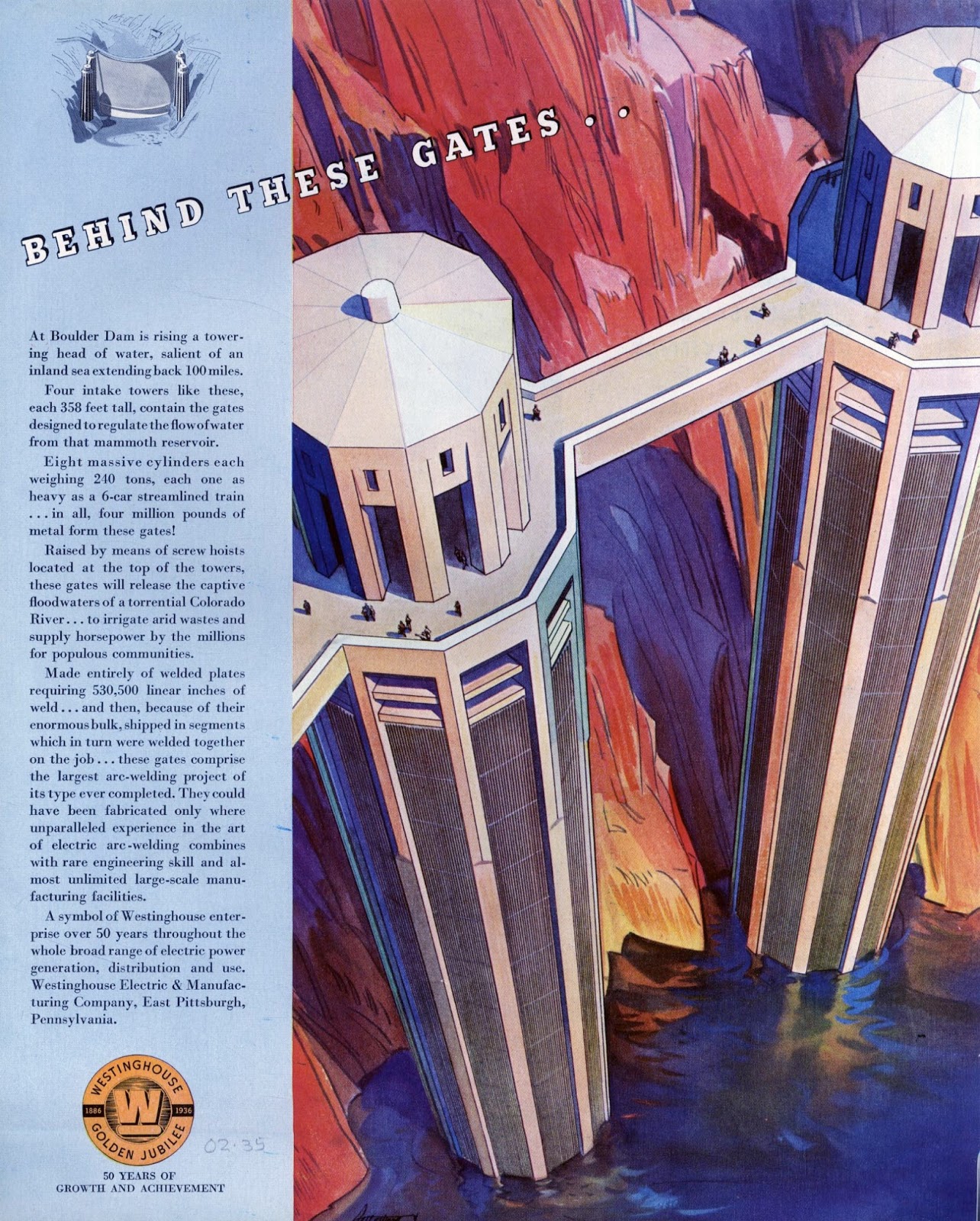
The Hoover Dam is a concrete arch-gravity dam in the Black Canyon of the Colorado River, on the border splitting Nevada and Arizona. From 1931 to 1936, over four million cubic yards of concrete and eighty-eight million pounds of plated steel were used. And with the removal of rock from the canyon walls, boring four diversion tunnels, and the sacrifice of more than 100 lives, the dam quickly became a symbol of the American "can-do" spirit. For millions of people in the 1930s, Hoover Dam, and on a lesser scale, the Empire State Building, came to symbolize what American workers could do even in the depths of the Great Depression. 

When President Herbert Hoover lost the White House in 1932 to President Roosevelt, his new Interior Secretary, Harold Ickes, snubbed the Hoover name from the day of the dam’s dedication. “This great engineering achievement should not carry the name of any living man but, on the contrary, should be baptized with a designation as bold and characteristic and imagination-stirring as the dam itself.” His political bias blotted out the fact that Presidents Woodrow Wilson, Theodore Roosevelt, and Calvin Coolidge already had dam sites attached to their names. 

As a former mining engineer, Hoover took an active part in settling the engineering problems and the location of the dam in Black Canyon. When he left office, construction finished more than a year ahead of schedule. The Hoover name was vindicated when House Resolution 140 was introduced and passed by the 80th Congress in 1947. President Harry S. Truman signed the resolution and restored the name Hoover Dam to the structure. To clarify, the names "Boulder Canyon Dam" and "Boulder Dam" were simply references to nearby Boulder City, Nevada, and not official. Almost a million people still come to visit the huge dam every year.

Note: The illustration above highlights the intake towers before Lake Mead was filled to its normal operating level.

Tuesday, June 10, 2025

RKO Blood on Fort Apache

The films below were released by RKO Radio Pictures in 1948, and they are two famous Western films with different premises. Though both deal with a clash of personalities, one is a traditional Western, while the other is a shadowy, moody, noir Western.

Fort Apache
Released March 27, 1948, Fort Apache is an American Western saga, the first of John Ford's "Cavalry Trilogy." It was followed by She Wore a Yellow Ribbon (1949) and Rio Grande (1950), all starring John Wayne. The film was one of the first to present an authentic and sympathetic view of Native Americans.

Wayne's substantial co-star is Henry Fonda, supported by a talented cast including Shirley Temple, Pedro Armendariz, and John Agar. Cinematography is by Archie Stout. Fonda plays an arrogant and abrasive Lieutenant Colonel in command of Fort Apache, much to Wayne's disappointment, who had expected to receive that commission.

Blood On The Moon

Released November 9, 1948, Blood on the Moon is considered one of the best noir Westerns, in contrast to the sunlit saga of Fort Apache. It is a moody, "psychological" film starring Robert Mitchum, a role that neither Wayne nor Fonda could pull off. There is little of the Western formula approach to this story. The supporting cast includes Robert Preston, Walter Brennan, and Barbara Bel Geddes. The film is directed by another legend in cinema, Robert Wise. The outstanding cinematography is by Nicholas Musuraca. 

Of note is an extended fight between Mitchum and Preston without any stuntmen. Then again, it took three days to shoot. Wise wanted realism, where the winner is also badly beaten and exhausted, instead of a cliched brawl where the hero comes out clean and unscathed. Mitchum's acting was lauded at the time, whereas both Wayne and Fonda somewhat cancelled each other out of any accolades.

Note: 
From a budget of approximately $2.1 million, Fort Apache had a box office total of $3 million. Blood On The Moon made a decent profit out of a $1.5 million budget with a $2.4 million box office take.

Tuesday, May 27, 2025

The Chocolatier of 1900


The history of the chocolate bar, similar to what we know today, dates back to the 19th century. But solid chocolate was probably consumed in pre-Columbian America. In 1847, however, Joseph Fry created the first proper mass-produced chocolate bar by mixing cocoa powder, sugar, and cocoa to form a paste that could be pressed into a mold. This moved it from a beverage to a solid, edible treat.

In 1875, milk chocolate came onto the scene. It was developed by a Swiss confectioner, Daniel Peter, with the help of his neighbor, Henri Nestlé, who specialized in dehydrated milk products. This development significantly improved the taste and palatability of chocolate, leading to its widespread popularity.

1984 marked a significant milestone in the chocolate industry, thanks to Milton Hershey (in all his chocolatey goodness, above). The Hershey Company introduced its first candy bar in 1900, the Hershey's Milk Chocolate Bar. This transformed chocolate from a luxury item into an affordable and "block by block" accessible treat.

Other notable early chocolate bars include the Lindt Chocolate Bar, 1879, and the Baby Ruth candy bar, developed by Otto Schnering in 1920, which became the most popular candy bar in America by 1925. The evolution of chocolate bars continued with the inclusion of various ingredients such as nuts, caramel, and nougat, leading to the creation of candy bars like the Goo Goo Cluster, invented in 1912.

Tuesday, May 20, 2025

Television Suits You

In the second half of the twentieth century, the Botany 500 name for the wardrobe ending credits of many television programs was as common as Gunsmoke. The brand's association with television personalities helped it become a household name. Throughout the 1970s, Botany 500 provided menswear for many game show hosts and countless television stars. That list can be found online. Botany 500 often paid for the clothes of television celebrities and did not always provide the clothes themselves. They were sometimes custom-made by other tailors.

Botany 500 was a brand name owned by the Botany 500 Group of New York. Beginning in 1889, their men's suits and sport coats were manufactured in Philadelphia, Pennsylvania, by H. Daroff and Sons, who were contracted with Botany Mills of Passaic, New Jersey, to produce products and later bought the firm outright. Given the exaggerated proportions of the 1949 illustrated man above, one could assume he was once the center of an NBA team. His forty-inch inseam would not be a challenge for Daroff.

Daroff and Sons and the Botany group went bankrupt in the summer of 1973. An attempt was made to turn the company over to another company, still operating profitably. Because of resistance by the company's employees, they backed out of the deal. By the winter of 1973, Cohen and Sons bought the Botany 500 name and assets for $4 million. They planned to keep the labels, marketing, sales, and distribution of Botany as a separate Botany 500 line produced in Philadelphia.
The Botany 500 name lives on as a licensed property of several foreign clothing manufacturers, ending the exclusivity of Botany 500's glory days. In 2021, the Botany 500 name resurfaced as a brand name sold by the mail-order company Haband