Showing posts with label illustrator. Show all posts

Wednesday, August 7, 2024

Imitation Is The Best Compliment


Al Parker (1906-1985) defined the progressive look and feel of published imagery at a time of sweeping change, when Americans, emerging from the great depression and War, sought symbols of hope and redemption on the pages of our nation’s periodicals. His innovative modernist artworks created for mass-appeal women’s magazines and their advertisers captivated upwardly mobile mid-twentieth century readers, reflecting and profoundly influencing the values and aspirations of American women and their families during the post-war era. 

Parker is credited with creating a new school of illustration and was much imitated. To distinguish himself from his imitators, he worked in a variety of styles, themes, and media. Examples range from children's crayons to acrylics. He sold illustrations to Cosmopolitan, Good Housekeeping, McCall's, The Saturday Evening Post, Sports Illustrated, Town and Country, and Vogue. A stamp commemorating his art was issued by the United States Postal Service in 2001 as part of the American Illustrators Issue series. 

Wednesday, June 26, 2024

An Influential Illustrator


Bob Peak (1927-1992) was an award-winning American illustrator whose mixed media, sketchy style contributed thirty years to the film industry. He was famous for his many cover illustrations for TV Guide, other magazine advertisements, USPS stamps, and portraits.

What about Bob.

Wednesday, May 15, 2024

Charles Wysocki, Part Two


Charles Wysocki (1924-2002) was famously known for his clean, well-designed American folk art illustrations, a subject I focused on in a previous post. Lesser known is his commercial advertising illustrations for Dodge trucks, among other industries. One can see leanings toward his non-dimensional, flat panels approach.

Wednesday, September 27, 2023

Supermarket Drive-In


Fred McNabb illustrated an idealistic series of futuristic concepts for the New Departure Manufacturing Company, founded in Bristol, Connecticut by innovators Albert and Edward Rockwell in 1901. By the way, Albert was also the founder of the Yellow Taxicab Company of New York. New Departure later became a division of General Motors. 

The above 1956 illustration seems to have numerous details that are mystifying, at the very least, like the conveyor belt for sending out groceries on a rainy day. I cannot imagine this concept succeeding east of the Rocky Mountains in the winter. Plus loading the preferred brands one is there to purchase. They did seem to envision the drivers' ability to open the trunk from inside the 1959 models, however. Not being able to comprehend there will be more than seven shoppers at a time is a huge oversight. Let alone the idling cars behind as if at a McDonald's drive-up window. Optimistically, perhaps these were the "express lanes" when shopping for no more than twenty items. One had to shop inside the store for a full shopping experience. Without ever knowing it, it seems the bazaar illustration was heading in the right direction regarding "remote" buying. What McNabb and New Departure could not have possibly envisioned was the Internet. Or shutting down the economy in 2020. Shopping without ever meeting any live person has become common for those who experience "life" via a Smartphone.

See McNabb's full-page ads here.

Monday, July 24, 2023

Action-filled Compositions


Peter Helck (1893-1988) was an American illustrator who specialized in depicting the racing circuits of Europe. He estimated that he had produced more than 600 sketches, drawings and paintings during his career. He was there in the early days of auto racing with the Vanderbilt Cup Race of 1906. He worked for many of the major automobile magazines, in particular The Autocar, which took him to England and to major races in France and Italy. In the 1930s Helck was commissioned by the Sinclair Oil Company to produce a large-format road map. This map did much to build Sinclair's reputation and to promote driving for pleasure.

His compositions became more well-known, he also successfully pursued a path in commercial work, becoming an acknowledged expert in the portrayal of industrial subjects and machinery. Among others, his advertising work included Packard, TWA, Caterpillar Tractor, Sinclair Oil, GE, Mack Trucks, Alcoa, and Republic Steel. Perhaps his most famous US series was with the Chevrolet truck division of General Motors in the 1950s. His work made him a first-rate salesman, too. The details of these paintings placed the viewer within the scene and suggested Chevrolet was apparently the only truck manufactured. One source of his realism was that he painted on location, not from photographs. Though he obviously combined various subjects for a completed utopian painting.

Wednesday, November 24, 2021

More Appreciated After Death


Artist and author, Eyvind Earle (1916-2000), possessed a distinctive graphic design approach for many of his landscape interpretations. The suggested low light, perfectly round silhouette of trees, and bright colors were surrealistic in certain works. Earle began his long and successful career of selling Christmas cards in 1939 that he designed and printed himself for the American Artist Group. He created over 800 designs through 1995 and sold more than 300 million copies. Earle joined Walt Disney Productions in 1951 as an assistant background painter and received credit for his experimental background paintings. Earle returned to full-time painting in the mid-sixties, producing watercolors, oils, sculptures, drawings, scratchboards, and limited-edition serigraphs. Much of his work was never exhibited in his lifetime, but The Metropolitan Museum of Art, Rahr West Art Museum, Phoenix Art Museum and Arizona State University Art Museum purchased Earle's works and are among their permanent collections. 

More stunning works at: Eyvind Earle

Friday, August 13, 2021

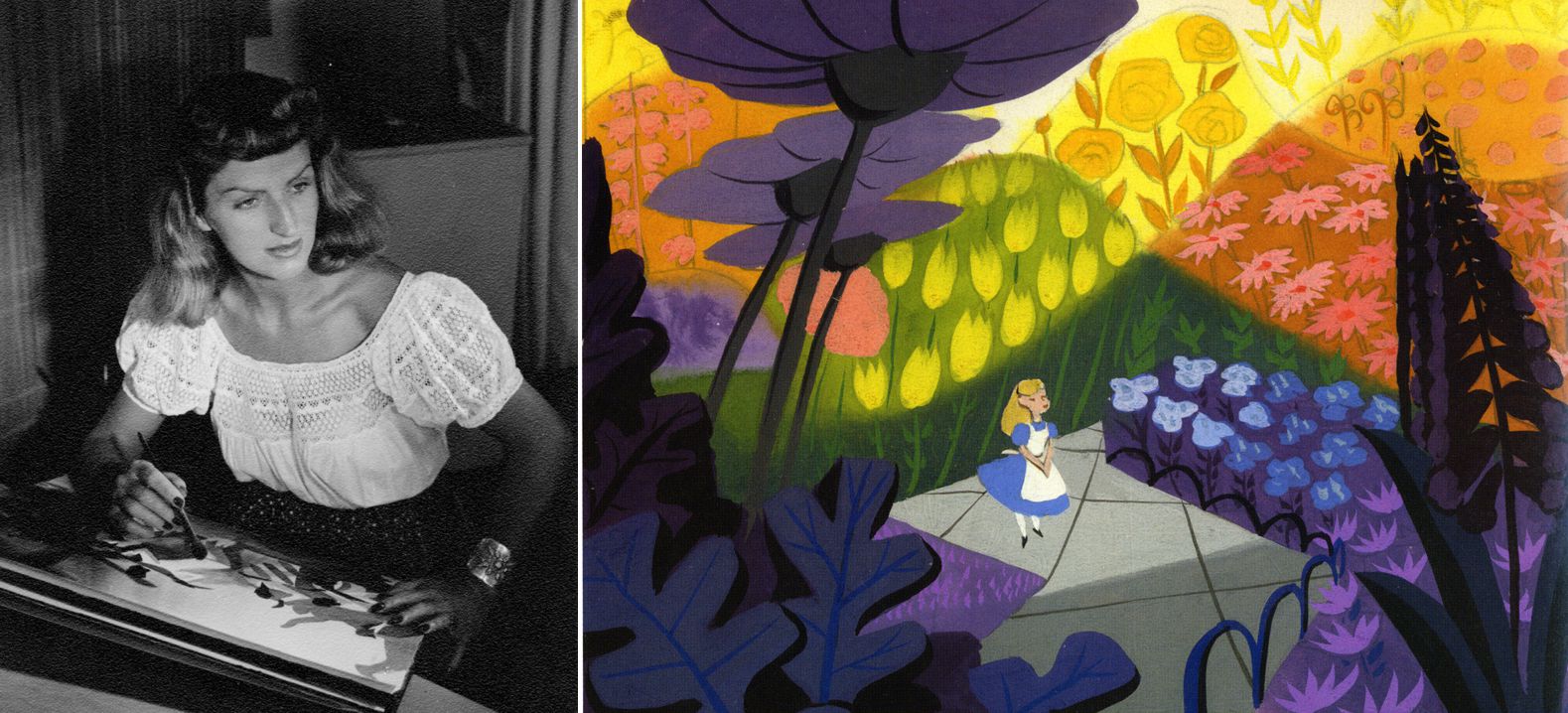
The Lady and The Walt


Mary Blair (1911-1978) was one of Walt Disney’s favorite artists, joining The Walt Disney Company in 1940 where she created concept paintings for projects related to Fantasia (1940), Dumbo (1941), and The Lady and the Tramp (1955). Blair learned her craft at The Chouinard Art Institute in Los Angeles in the mid-1930s. She and her husband, Lee Blair, also a Disney employee, accompanied Disney and several of his artists on a South American tour in 1941. Upon their return, Blair created concept art that ended up being used for films inspired by the trip. Her imagination and use of bright colors was a perfect fit for Disney's fantasy films but left Disney in 1953 to concentrate on illustrating children’s books, most notably, a series of Little Golden Books. Walt Disney did convince Blair to work on Disney’s contribution to the 1964 World’s Fair in New York. Her concept art on this project would be her final major design work for Disney. The “It's a Small World” ride proved extremely popular and was later adapted for Disneyland and Disney World.

Friday, July 2, 2021

The Illustrator As Salesman


Bernd Reuters (1901-58) was a German illustrator who created stylish Volkswagen promos that stressed streamlined functionality over flourish in the mid-50s. With the rise of Volkswagen in the late 1940s, Reuters began a five or six-year run of producing striking, distinctive brochure images for the firm, some of which continued to be used following his death from a heart attack. His exaggerated upscale impressions were dreamy and perhaps made one drive to a showroom as soon as possible. More illustrations at: Bernd Reuters

Wednesday, June 16, 2021

A Short Prolific Career


Richard Amsel (1947-1985) was an American illustrator and graphic designer. His brief career was prolific, including movie posters, album covers, and magazine covers. His portrait of comedian Lily Tomlin for the cover of Time is now part of the permanent collection at the Smithsonian Institution. Amsel's illustrations were sometimes created in only two or three days because of stringent deadlines. His thirteen-year association with TV Guide showcased perhaps his most visible work. His strong, flowing lines, design of negative space, and accurate representation of a subject was a trademark. That, and his logo-styled name on his work.

Wednesday, May 26, 2021

A Maxfield Parrish Sky


Maxfield Parrish (1870-1966) was one of the most popular artists during the Golden Age of Illustration. During the 1920s, it has been estimated that a quarter of all American households displayed a Parrish print on their walls. His other-worldly landscapes of ancient gnarled trees, tumbling waterfalls, azure skies, or nursery rhymes were painted with a dreamlike clarity. Parrish's art is characterized by vibrant colors; the color Parrish blue was named after him. He achieved such luminous color through glazing. This process involves applying alternating bright layers of translucent glaze separated by varnish over a base rendering. 

One of his techniques set the stage for future commercial illustrators working with constant deadlines. Some models were clothed in geometric patterns, enabling him to accurately capture the distortion and draping. Though a "grid system" produced similar accuracies before photography, Parrish would take photos of projected objects, cut the prints out and place them onto his canvas, then cover them with clear glaze. The American painter Norman Rockwell considered Parrish his idol.

Friday, May 7, 2021

Al Parker (1906-85)


Al Parker was an innovative, influential modernist illustrator with mass appeal in women’s magazines. He emerged in the mid-1930s with is move to NYC and established a vibrant visual vocabulary for the new suburban life so desired in the aftermath of the Depression. More graphic and less detailed than the paintings of the influential Norman Rockwell, Parker’s stylish compositions were sought after by editors and art directors for their contemporary freshness. Parker is credited with creating a new school of illustration and was much imitated. To distinguish himself from his imitators, he worked in a variety of styles, themes and media, from children's crayons to acrylics. In cooperation with the magazine's art director, he secretly provided every illustration in an issue of Cosmopolitan, using different pseudonyms, styles and mediums for each story.

See additional Al Parker samples.