Wednesday, December 29, 2021

On The Precipice of Stardom


Marsha Hunt (Marcia Virginia Hunt 1917-) is an American actress with a career spanning over seventy-five years. As of this writing, she is the oldest living and one of the last surviving actors from the Golden Age of Hollywood. She is also the oldest living member of the Academy of Motion Pictures Arts and Sciences. Unable to find a suitable college for her drama training, the Chicago-born native found work modeling for the John Powers Agency and began taking stage acting classes at the Theodora Irvine Studio. She was one of the highest-earning models by 1935. She appeared in popular films including Pride and Prejudice (1940), in which she was quite amusing, Cry 'Havoc' (1943), The Human Comedy (1943), and one of her last noted films before the advent of television was, Raw Deal (1948). Hunt's 1941 contract with MGM kept her busy for six years, providing strong supporting characters.

Television offered mostly dramatic guest-starring roles from the Fifties through the Eighties. She played everything from grandmas to judges. Notable early performances were for Alfred Hitchcock Presents, two anthology series, Climax! and Zane Grey Theater, and numerous, well-hidden roles on detective or drama series during the Sixties and Seventies. She was a cast member for the fourteen-episode, Peck's Bad Girl (1959). The versatile actress never found superstardom yet her longevity proved valuable to many casting directors. Semi-retiring in the early Sixties, television and the stage remained her focal points.

The Western Gone Wrong

Tumbleweeds is a satirical perspective on the American frontier. The comic strip ultimately ran in over 300 newspapers from September 6, 1965, to December 30, 2007. Writer-artist Tom K. Ryan (1926-2019) offered deadpan humor to poke fun at all the clichés and stereotypes of western movies. Set in and around the town of Grimy Gulch with a population that hovered up or down of 50, it was one of the longest-running western comics made continuously by the same author. Ryan had a large following among Native Americans because of his respectful use of those characters. 

The comic strip was remarkable for its large cast of 50 wacky-named characters. The title character (above) got his namesake from the dried-out pieces of plants that tumble away in the wind. It symbolized the laconic cowpoke who has no real ambition to do anything. Much of the comic's humor came from its silly dialogue and the artist's over-the-top stylized characters for both humans and animals. Tumbleweeds is sometimes compared to Johnny Hart's popular B.C. or Wizard of Id strips. The comic strip's dry humor had a target audience, but aside from a nostalgic return, the strip has lost much of its relevance today. Good examples can be found at Tumbleweeds.

Note: From 1969 until 1978, Ryan's assistant was Jim Davis, of "Garfield" fame. Both men worked in Muncie, Indiana. 

Friday, December 24, 2021

Ignoring The 8th Commandment


On this day in 1974, Louis Clark Brock (1939-2020) was named Sportsman of the Year. The El Dorado, Arkansas native began his major league career with the Chicago Cubs in 1961 but spent the majority of his big league career as a left fielder for the St. Louis Cardinals as an outfielder. Brock is best known for his base-stealing record, once the major league career and single-season record-holder. Brock and his wife, Jackie, were both ordained ministers serving at Abundant Life Fellowship Church in St. Louis. 

Tuesday, December 21, 2021

It's Durward Not Durwood


Durward Kirby (Homer Durward Kirby, 1911-2000) was an American television host and announcer. Born in Covington, Kentucky, his family moved to Indianapolis, Indiana when he was 15. He graduated from Arsenal Technical High School in Indianapolis before entering Purdue University to study engineering. The lure of being a radio announcer won out. 

Though Kirby appeared as a host, announcer, or guest on other television programs, most notably as co-host on Allen Funt's show, Candid Camera, his tenure as a regular on television's The Garry Moore Show brought him national attention as did another regular, Carol Burnett. The versatile performer acted in sketches, sang, and danced, transitioning with ease from slapstick to suave product pitchman. He and Moore joined forces for humorous skits, spoofing a historical event, or portraying any number of comical characters. The 6' 4" Kirby's mellow personality served him well, often becoming a foil in skits. Kirby authored three books: My Life, Those Wonderful Years; Bits and Pieces of This and That; and a children's book, Dooley Wilson.

Thursday, December 16, 2021

A Noted Television Composer


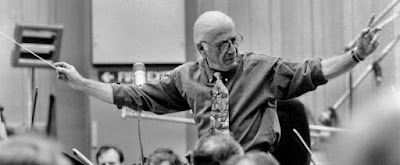
Jerry Goldsmith (Jerrald King Goldsmith 1929-2004) was an American composer and conductor known for his vast work in the film industry but also for television scoring and concert works. He composed scores for five films in the Star Trek franchise and three in the Rambo franchise, as well as for Logan's Run, Planet of the Apes, Patton, Chinatown, Alien, Poltergeist, Gremlins, Hoosiers, Air Force One, and many others. His 1997 opening fanfare for Universal Pictures debuted with the release of The Lost World: Jurassic Park. His silver screen compositions continued into the Twenty-first Century. "Among his many other works" is synonymous with Goldsmith. His film scores were not always identified with him, ranging from light and melodic to very dissonant scores in a style where the melody is nearly non-existent, like many of his influences of early 20th-century composers.

Goldsmith found early work at CBS in 1950 as a clerk typist in the network's music department under director Lud Gluskin. There he began writing scores for radio shows, later progressing into scoring live CBS television anthology series. As the decade progressed, he scored multiple episodes of the television series The Twilight Zone and Dr. Kildare. Goldsmith composed the theme for The Man from U.N.C.L.E. in 1964 and later added his touch to the James Bond parody, Our Man Flint, 1966, and its sequel In Like Flint, 1967. His military/action flare with snare drums was sometimes a giveaway during this period. His most notable television theme in the Nineties was the theme for the UPN series Star Trek: Voyager in 1995. He won a Primetime Emmy Award for Outstanding Main Title Theme Music. It is the most beautifully constructed theme of any Star Trek television series. His score and theme for Star Trek: The Motion Picture, 1979, was later used on the popular television series, Star Trek: The Next Generation in 1987 with an arrangement by Dennis McCarthy.

Note: Goldsmith was good friends with fellow composer, Morton Stevens, of Hawaii Five-O theme fame. Stevens also wrote the theme to television's Police Woman. Goldsmith confessed he used that theme for his Derek Flint character film series. He turned Steven's theme "inside-out" but the melody is lifted intact. Both composers were amused by the reuse.

Wednesday, December 15, 2021

Approved by Dale Evans

Penny Edwards (Millicent Maxine Edwards 1928–1998) was an American actress on stage, film, and television. The particularly obscure actress was performing on Broadway at twelve before being cast about a decade later in her first film, My Wild Irish Rose in 1947. Around this time, during Dale Evans' pregnancy leave, the vivacious blue-eyed blonde filled Evan's role opposite Roy Rogers in several B-movie western films, Trail of Robin Hood, Spoilers of the Plains, Heart of the Rockies, and In Old Amarillo, among others. Evans specifically requested her. She took a break from the saddle with two 1951 crime noir films, Missing Woman and Million Dollar Pursuit.

Though Edwards announced her retirement in 1954, she returned to appear in a number of television shows, among them were Cheyenne, The Restless Gun, Bachelor Father, The Adventures of Ozzie and Harriet, Alfred Hitchcock Presents, and Perry Mason, before ending her career with two appearances on Death Valley Days in 1958 and 1961. Her main focus after retirement was devoting herself to Christian service.

Tuesday, December 14, 2021

Last Lunar Footsteps


On this day in 1972, the Ascent Stage of the Apollo 17 Lunar Module Challenger lifted off from the landing site in the Taurus-Littrow Valley, The Moon. Onboard were Mission Commander Eugene A. Cernan (above) and the LM Pilot, Harrison H. Schmitt. The Command Module was piloted by Ronald Evans. Cernan and Schmitt had been on the surface of the Moon for 3 days, 2 hours, 59 minutes, 40 seconds. During that time they made three excursions outside the lunar lander, totaling 22 hours, 3 minutes 57 seconds. Apollo 17 was the last manned mission to the Moon in the Twentieth Century with Cernan as the last man to stand on the surface of the Moon. Apollo 17 was the first mission to have no one on board who had been a test pilot. X-15 test pilot Joe Engle lost the lunar module pilot assignment to Schmitt, a geologist.

More details at Apollo 17